


Think math always wins? Not always.
The debt avalanche targets the highest interest rates to cut total interest, while the snowball pays the smallest balances first to build momentum and keep you on track.
In many cases avalanche saves the most money, but a real example shows they’re often nearly tied: snowball finished in 25 months and saved $2,251; avalanche finished in 26 months and saved $2,213.
Which method saves you more depends on your mix of balances and whether you need early wins to stick with the plan.
Read on to learn how to pick the smarter option for your situation.
Core Comparison of Debt Snowball and Debt Avalanche Strategies

The debt snowball method pays your smallest balances first to build momentum. The debt avalanche method pays your highest interest rate debts first to minimize total interest. Both require making minimum payments on all accounts and applying extra dollars to one target debt at a time.
Snowball is a behavioral strategy. It creates quick wins by eliminating small balances fast, which keeps you motivated to stick with the plan. Avalanche is a mathematical strategy. It targets the debts costing you the most in interest charges, reducing your total payoff cost and often shortening the timeline when high rate balances dominate your debt mix.
In a side by side example using the same starting debts and a household budget allowing an extra $100 per month, the original minimum payment only plan would take 50 months to finish. The debt snowball method paid everything off in 25 months and saved $2,251 in interest. The debt avalanche method paid everything off in 26 months and saved $2,213 in interest. Snowball finished one month faster and saved an extra $38 in this scenario because the smallest debt also carried a high interest rate.
Here’s what that means for you:
Snowball delivers faster visible progress when you have multiple small balances that can be eliminated quickly.
Avalanche usually saves the most interest when you have large high APR balances like credit cards at 20 percent or more.
Both methods save substantially compared to paying minimums forever. Either plan reduces your payoff timeline and interest costs dramatically.
Your debt mix determines which method wins mathematically. If your smallest balance happens to have the highest rate, snowball and avalanche converge.
Your motivation and discipline determine which method you’ll finish. Snowball is easier to sustain for many people. Avalanche requires patience through a longer first payoff.
Understanding the Snowball Method for Paying Off Debt

The snowball method prioritizes your smallest outstanding balance regardless of interest rate. You list all your debts from smallest to largest, make minimum payments on everything, and direct every extra dollar to the smallest debt until it’s gone. When that balance hits zero, you take the payment you were making on it and roll it into the next smallest debt. This creates a snowball effect where each payment grows larger as debts disappear.
The rationale is entirely behavioral. Paying off a $500 medical bill or a $1,200 store card gives you a tangible win within weeks or a few months. That psychological boost increases your likelihood of sticking with the plan. Research on habit formation and goal completion shows that early, visible progress reduces the abandonment rate of long term projects. Snowball turns debt repayment into a series of short sprints instead of one marathon.
Key behavioral benefits:
Quick elimination of accounts reduces the mental load of tracking multiple creditors and due dates.
Visible momentum builds confidence that the plan is working, which reinforces continued effort.
Simplicity makes the method easy to explain and easy to follow without complex calculations or rate comparisons.
Higher completion rates among people who have previously abandoned repayment plans or feel overwhelmed by debt.
Step by Step Snowball Method Process (How It Works)

List all debts from smallest balance to largest. Include credit cards, medical bills, personal loans, car loans, and student loans. Write down the current balance, minimum payment, and interest rate for each. Ignore the APR for ordering purposes. Balance size is the only factor that matters here.
Pay the minimum on every debt except the smallest. This keeps all accounts current and avoids late fees or credit damage. Take any cash you have left after minimums, whether that’s $50, $100, or $300, and add it to the minimum payment on your smallest balance.
When the smallest debt is paid off, roll its full payment to the next smallest balance. If you were paying $150 total on the first debt, add that $150 to the minimum payment on the second debt. This accelerates the second payoff, which then rolls into the third, and so on.
Roll over payments are what turn snowball into a powerful debt reduction engine. Each eliminated balance frees up cash that compounds into the next target. By the time you reach your largest debt, you’re attacking it with the combined payment power of every smaller debt you’ve already cleared. This acceleration shortens your total timeline and keeps the strategy emotionally rewarding at every stage.
Real Snowball Method Numeric Example

Here’s a realistic scenario. You have three debts and can afford an extra $100 per month beyond minimums. Your debts are a $2,000 car loan at 4 percent APR ($75 minimum payment), a $5,000 personal loan at 17 percent ($150 minimum), and a $20,000 credit card at 20 percent ($200 minimum). Your total minimum payment obligation is $425 per month. You have $525 available, so $100 goes to the snowball target.
| Debt (Smallest to Largest) | Payment Applied | Months to Payoff |
|---|---|---|
| Car loan ($2,000 @ 4%) | $175 ($75 minimum + $100 extra) | 12 months |
| Personal loan ($5,000 @ 17%) | $325 ($150 minimum + $175 rolled over) | 17 months (starts after car loan paid) |
| Credit card ($20,000 @ 20%) | $525 ($200 minimum + $325 rolled over) | Remaining months until all debt cleared |
In this snowball example, the total payoff takes 25 months and saves $2,251 in interest compared to a minimum payment only plan that would have dragged on for 50 months. Snowball performed especially well here because the smallest debt also carried a low interest rate, so eliminating it quickly didn’t defer much interest accumulation. The method kept motivation high with a car loan payoff in the first year, then channeled that momentum into the higher rate debts with ever increasing payment power.
Pros and Cons of the Snowball Method
Pros:
Creates fast psychological wins by eliminating small balances within weeks or months.
Simple to implement. Order debts by balance and ignore interest rates, reducing decision complexity.
High adherence and completion rates because visible progress keeps you motivated.
Reduces the number of creditors and monthly bills quickly, lowering mental load and administrative hassle.
Cons:
Can cost more in total interest if high APR balances are deferred while you pay small low rate debts first.
May extend total payoff time in scenarios where large high interest balances linger.
Ignores interest rates entirely, which means you might miss opportunities to stop expensive interest accumulation sooner.
Not always optimal for minimizing cost. Depends heavily on the specific mix of balances and APRs in your debt portfolio.
Understanding the Avalanche Method for Minimizing Interest Costs

The debt avalanche method prioritizes debts by annual percentage rate, targeting the highest APR balance first. You list all your debts from highest interest rate to lowest, make minimum payments on everything, and direct every extra dollar to the debt with the steepest rate. When that debt is paid off, you move to the next highest APR and repeat the process until all debts are cleared.
Avalanche is the mathematically optimal repayment strategy in most cases. High APR debts accumulate interest faster, so paying them off early reduces the total interest you’ll pay over the life of all your debts. A $15,000 credit card balance at 23 percent APR costs you $3,450 per year in interest charges alone. A $10,000 car loan at 5 percent costs $500 per year. Attacking the 23 percent balance first stops the bleeding where it’s worst.
Three key cost benefits:
Minimizes total interest paid by eliminating the highest cost debt first, which compounds savings over time.
Often shortens overall payoff timeline when high rate balances are large, because less of your payment goes to interest and more reduces principal.
Provides peace of mind that you’re taking the most cost effective path, especially valuable if you’re rebuilding after financial stress or managing a tight budget where every dollar counts.
Step by Step Avalanche Method Process (How It Works)
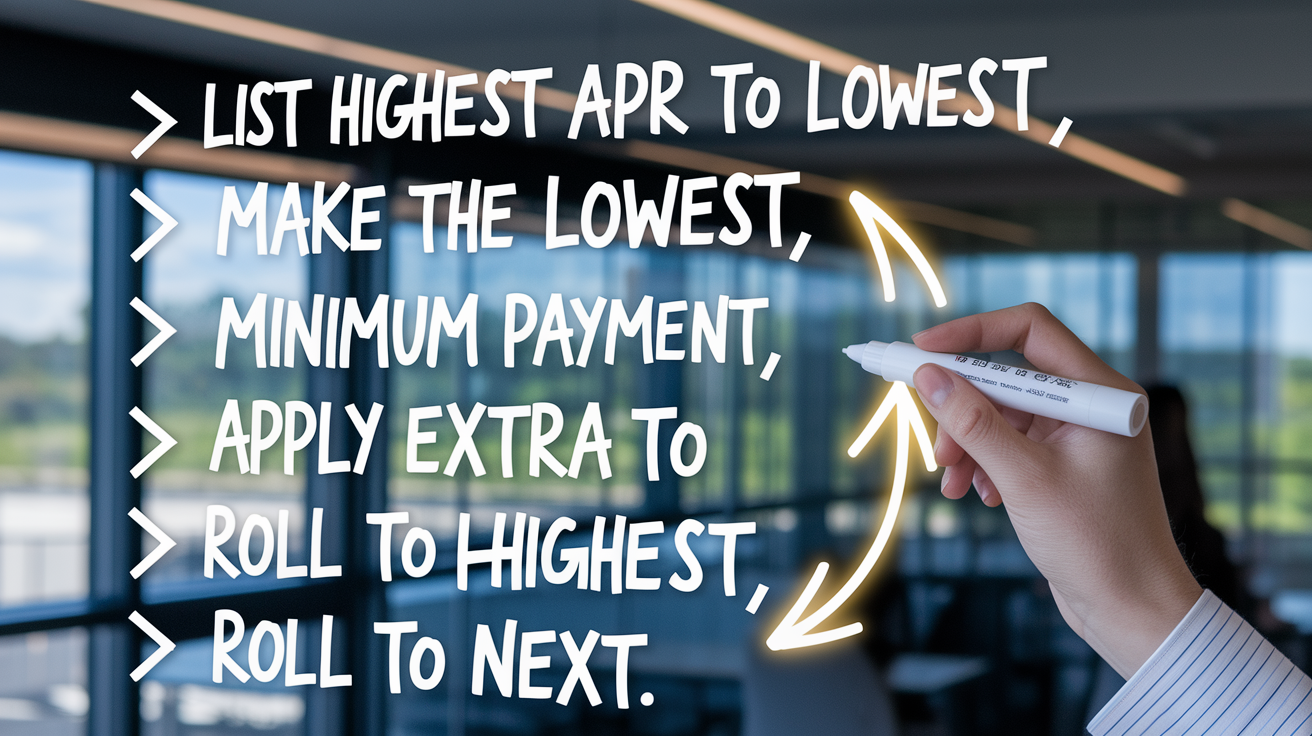
List all debts from highest APR to lowest. Include credit cards, personal loans, student loans, car notes, medical bills. Anything with an interest charge. Write down the balance, APR, and minimum payment for each. Mortgages are typically excluded from avalanche payoff plans because of their low rates and tax considerations.
Make the minimum payment on every debt. This keeps all accounts in good standing and avoids late fees, penalty APRs, or credit report damage.
Apply all extra monthly funds to the debt with the highest interest rate. Whether you have $50 or $500 left after minimums, add it to the payment on your highest APR debt until that balance is paid in full.
When the highest APR debt is paid off, roll its payment to the next highest APR. Repeat the process, moving down your rate ordered list until all debts are cleared.
Avalanche front loads the hardest work. Your first target may be a large credit card balance that takes 12 or 18 months to eliminate, which feels slow compared to snowball’s early wins. But every dollar you put toward that high rate debt saves you interest compounding at 20 percent or more. The long term payoff is lower total cost and often a shorter overall timeline once the expensive debts are gone and you’re rolling large payments into the remaining low rate balances.
Real Avalanche Method Numeric Example
Using the same three debts and $100 extra monthly budget: $2,000 car loan at 4 percent, $5,000 personal loan at 17 percent, $20,000 credit card at 20 percent. Minimums total $425, you have $525 available. Avalanche orders debts by APR: 20 percent credit card first, then 17 percent personal loan, then 4 percent car loan.
| Debt (Highest to Lowest APR) | APR Priority | Payment Applied |
|---|---|---|
| Credit card ($20,000 @ 20%) | 1st (highest APR) | $300 ($200 minimum + $100 extra) |
| Personal loan ($5,000 @ 17%) | 2nd | $450 ($150 minimum + $300 rolled over after card paid) |
| Car loan ($2,000 @ 4%) | 3rd (lowest APR) | $525 ($75 minimum + $450 rolled over) |
The avalanche method pays everything off in 26 months and saves $2,213 in interest compared to the 50 month minimum payment plan. Avalanche is one month slower than snowball in this example and saves $38 less total interest. That’s unusual. Normally avalanche saves more. Here, the outcome converged because the smallest debt (the car loan) also had the lowest APR, so snowball’s sequencing happened to defer very little high rate interest. In most real world debt mixes where small balances carry moderate or high rates, avalanche will deliver greater interest savings and a comparable or shorter timeline.
Pros and Cons of the Avalanche Method
Pros:
Minimizes total interest paid by attacking the most expensive debts first.
Often results in the shortest payoff timeline when high APR balances are substantial.
Mathematically optimal strategy for reducing total cost of debt repayment.
Especially effective when credit card debt at 18 percent to 25 percent dominates your balance sheet.
Cons:
First debt payoff can take many months if your highest APR balance is large, reducing early psychological reinforcement.
Requires discipline and patience to stay committed without quick wins.
Can feel discouraging if you don’t see account balances disappear for a year or more.
Higher risk of plan abandonment for people who need frequent motivation or have struggled to finish repayment plans in the past.
Side by Side Comparison of Snowball vs Avalanche Results
| Method | Months to Payoff | Total Interest Saved | Motivational Impact |
|---|---|---|---|
| Debt Snowball | 25 months | $2,251 | High: quick wins every few months |
| Debt Avalanche | 26 months | $2,213 | Moderate: slower initial progress, greater long term satisfaction |
The example above shows snowball finishing faster, but that’s because the debt mix happened to align smallest balance with lowest APR. In most portfolios, avalanche saves more interest and finishes in the same timeframe or faster. If your smallest debt carries a high interest rate, snowball and avalanche will target the same account first and produce identical results early on. If your smallest debt has a low rate and your largest debt has a high rate, avalanche pulls ahead on total savings. The exact outcome depends on how your balances and APRs are distributed. Run both scenarios through a debt payoff calculator using your real numbers to see which method saves you more.
When to Choose Snowball vs Avalanche Based on Your Situation
Use Snowball When:
You have several small balances under $2,000 that can be cleared within a few months.
You need quick wins to stay motivated and have a history of abandoning long term plans.
Behavioral momentum matters more to you than squeezing out every dollar of interest savings.
You feel overwhelmed by the number of creditors and want to simplify your financial life fast.
Use Avalanche When:
You have large high APR balances, $5,000 or more at 18 percent or higher, where interest accumulation is substantial.
Minimizing total interest cost is your top priority and you can maintain discipline without frequent payoffs.
You’re financially steady and motivated by long term math rather than short term psychological wins.
You can tolerate 12 to 18 months of working on the same debt before seeing it disappear.
A hybrid approach combines the best of both. Start with snowball to knock out one or two small debts in the first few months, then switch to avalanche to attack your highest rate balances. This gives you an early motivational boost without sacrificing much in total interest savings. If your first snowball payoff happens in 60 days, you’ve built momentum and can shift to avalanche with confidence that you’ll stick with the plan.
Practical Steps to Implement a Debt Payoff Plan
Create a complete debt inventory. List every creditor, current balance, APR, and minimum monthly payment. Include credit cards, personal loans, medical bills, car loans, and student loans. Skip your mortgage unless you’re aggressively paying it down ahead of schedule.
Build a zero based budget to find extra cash. Track every dollar of income and allocate it: rent, utilities, groceries, insurance, debt minimums, and savings. Whatever’s left is your debt attack fund. Budgeting strategies from Experian can help you identify spending cuts or reallocation opportunities.
Choose snowball or avalanche and order your debts accordingly. Smallest to largest for snowball, highest APR to lowest for avalanche. Write the target order and payment sequence down so you don’t have to recalculate each month.
Make minimum payments on all debts, then apply every extra dollar to your target. Set up automatic payments for minimums to avoid missed due dates. Manually send the extra amount to your priority debt each month.
When a debt is paid off, immediately roll its payment to the next target. Don’t let the freed up cash drift into discretionary spending. The rollover is what accelerates your timeline.
Track progress monthly and monitor your credit score. Use a simple spreadsheet or debt tracking app to log balances, interest paid, and months remaining. Celebrate each payoff milestone to reinforce the behavior.
Tracking prevents repayment drift. It’s easy to lose focus after a few months if you’re not watching balances shrink. Monthly check ins also let you adjust if your income changes, an interest rate spikes on a variable rate loan, or you receive a windfall like a tax refund that you can throw at debt. Monitoring your credit score shows the positive impact of falling balances and on time payments, which adds another layer of motivation.
Alternatives to Snowball and Avalanche for Reducing Debt
| Option | Typical Rates/Terms | Best For |
|---|---|---|
| Personal Loan | 6.7% to 35.99% APR; 12 to 120 months; $1,000 to $250,000 | Consolidating multiple high rate debts into one fixed monthly payment at a lower blended rate |
| Balance Transfer Card | 0% intro APR for 12 to 21 months; 3% to 5% transfer fee | Paying off credit card debt interest free if you can clear the balance before the promo ends |
| Debt Management Plan | Negotiated lower payments and rates; monthly fees $20 to $75; may require closing cards | Structured repayment when you can’t manage multiple creditors or need professional negotiation |
Alternatives can outperform snowball or avalanche if the numbers work in your favor. A personal loan at 9 percent that consolidates three credit cards at 22 percent cuts your interest rate by more than half and simplifies payments to one due date. A balance transfer card with 18 months at 0 percent lets you pay pure principal if you can clear the balance before the promo expires. But miss the deadline and deferred interest or a high ongoing APR can erase your savings. Debt management plans help if you’re behind or struggling, but they often require closing credit accounts, which can hurt your credit utilization ratio and available credit. Compare the total cost, timeline, fees, and credit impact of each alternative against snowball and avalanche using your actual debt numbers before committing.
Final Words
Choose a plan and start today: list your debts, pay minimums, and direct extra dollars to a target, either the smallest balance or the highest APR.
Quick recap: the snowball method builds momentum and, in our example, closed debts in 25 months and saved $2,251. Avalanche minimizes interest, finishing in 26 months with $2,213 saved. Snowball was one month faster and $38 better here; often avalanche wins on cost.
When choosing between debt snowball vs avalanche method, pick the one you’ll follow, track progress monthly, and expect steady, measurable progress.
FAQ
Q: Why would anyone use the snowball method instead?
A: Someone would use the snowball method instead because paying smallest balances first delivers quick wins, boosts motivation and consistency, and simplifies payments, even if it can sometimes cost a bit more interest.
Q: Why does Dave Ramsey recommend debt snowball and not debt consolidation?
A: Dave Ramsey recommends the debt snowball because quick wins build discipline and stop spending; he cautions against debt consolidation since it can mask habits, add fees, lengthen repayment, and still demand strict budgeting.
Q: What are the cons of the avalanche method?
A: The cons of the avalanche method are slower early progress and fewer quick wins, which can hurt motivation; it’s harder to stick with emotionally despite often saving the most interest over time.