


What if a single credit card balance can shave dozens of points off your score?
Credit utilization is the percent of your available revolving credit you’re using (think credit cards, store cards, HELOCs).
It’s one of the biggest things lenders and scoring models look at (often 20–30% of your score).
Knowing your ratio can help you boost your score fast.
This post shows exactly how to calculate overall and per-card utilization, what targets to aim for (single digits or under 30%), and three quick moves that tend to help most people.
Clear Breakdown of Credit Utilization and How It Works

Credit utilization is the percentage of your available revolving credit you’re currently using. It’s one of the biggest things lenders look at when they’re deciding whether you’re a safe bet. Unlike installment loans (think car payments, mortgages, student loans), utilization only applies to revolving accounts. Credit cards, personal lines of credit, and home equity lines of credit (HELOCs). The math is simple: divide what you owe on all revolving accounts by your total credit limit across those accounts, then multiply by 100.
Here’s how it works with two credit cards. Card A has a $500 balance on a $2,000 limit. Card B has a $500 balance on a $3,000 limit. You owe $1,000 total. Your total credit limit is $5,000. Divide $1,000 by $5,000 to get 0.20, then multiply by 100 for a 20 percent overall credit utilization. That 20 percent number is what scoring models look at when they’re building your credit profile.
Both per-card utilization and overall utilization matter. A scoring model might flag a single card maxed at 100 percent even when your total utilization sits at a moderate level. Lenders want to see controlled usage across every account, not just a healthy average. A card carrying a high balance relative to its limit can signal higher risk. Tracking individual card percentages alongside your overall ratio gives you a clearer picture of how creditors view your credit behavior.
Step-by-Step Guide to Calculate Credit Utilization Accurately

Calculating credit utilization manually takes minutes and requires only your most recent balances and credit limits. You’ll pull these numbers from your credit card statements or your online account dashboards. The formula stays the same whether you have one card or ten: balance divided by limit, multiplied by 100. Once you have the percentage, you’ll know whether you’re above or below common thresholds that lenders monitor.
Installment loans stay out of the equation entirely. Your car loan, mortgage, student loans, and personal installment loans don’t count toward revolving credit utilization. Only lines of credit that allow you to borrow, repay, and borrow again factor into the calculation. That includes standard credit cards, store cards, charge cards with spending limits, and any personal or home equity line of credit with a revolving balance.
- Add up the current balances on all your revolving accounts. This is the total dollar amount you owe across credit cards and lines of credit.
- Add up the credit limits on those same accounts. This is the total dollar amount of credit available to you.
- Divide your total balance by your total credit limit. The result is a decimal.
- Multiply that decimal by 100 to convert it into a percentage. That percentage is your overall credit utilization ratio.
For a single card example, say you have a $300 balance on a card with a $1,000 limit. Divide $300 by $1,000 to get 0.30. Multiply by 100, and your utilization is 30 percent. A balance of $300 on a $1,000 limit puts you right at the commonly referenced 30 percent threshold.
Now consider a lower balance scenario. If you owe $100 on that same $1,000 limit card, divide $100 by $1,000 to get 0.10. Multiply by 100 for 10 percent utilization. That 10 percent figure tends to align with higher credit scores because it shows you’re using credit lightly and managing balances well below your available limit.
Per-Card Utilization vs Overall Credit Utilization
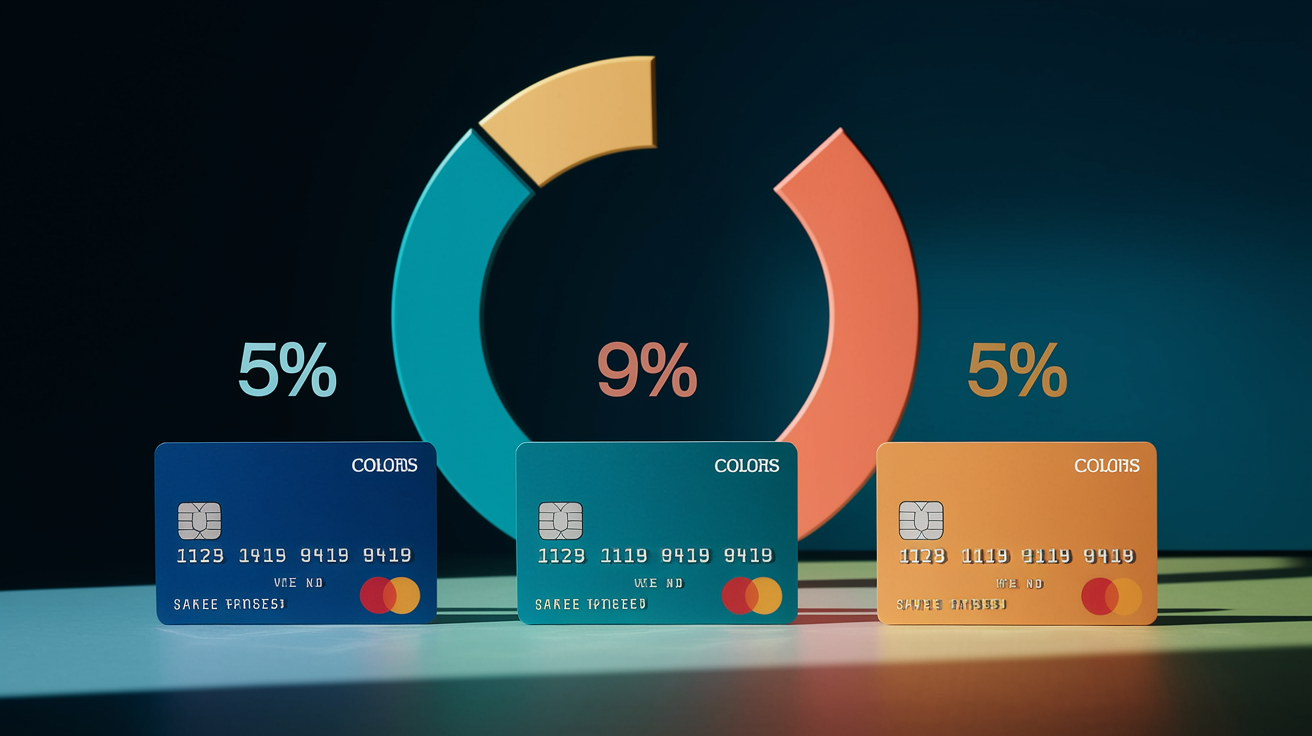
Overall utilization tells you the big picture percentage across all revolving accounts, but per card utilization can reveal red flags that the overall number hides. If you have three cards and one is maxed out while the other two sit at zero, your overall utilization might look moderate. The maxed out card, however, can still hurt your score because scoring models review both the aggregate percentage and the highest individual account percentage. A single card pushed to its limit signals you’re leaning heavily on that credit line, which lenders interpret as elevated risk.
Calculating per card utilization uses the same formula: divide the card’s balance by that card’s limit, then multiply by 100. Do this separately for each card. You might discover that one account sits at 80 percent while another sits at 5 percent, even though your combined utilization is 40 percent. That imbalance matters more than the average suggests.
When one card is maxed and others are idle: A $5,000 limit card maxed at $5,000, a $2,000 limit card maxed at $2,000, and a $3,000 limit card with a $0 balance give you $7,000 in total balances on $10,000 in total limits. That’s 70 percent overall. If you close the unused $3,000 card, your total limit drops to $7,000 while your balance stays at $7,000, pushing you to 100 percent utilization.
When applying for new credit: Lenders often review your highest per card utilization alongside your overall ratio. A single card at 90 percent can trigger concerns even if your total utilization is 25 percent.
When trying to improve your score quickly: Paying down the card with the highest utilization percentage often delivers a faster score lift than spreading payments evenly across all cards.
Ideal Credit Utilization Percentages and Benchmarks
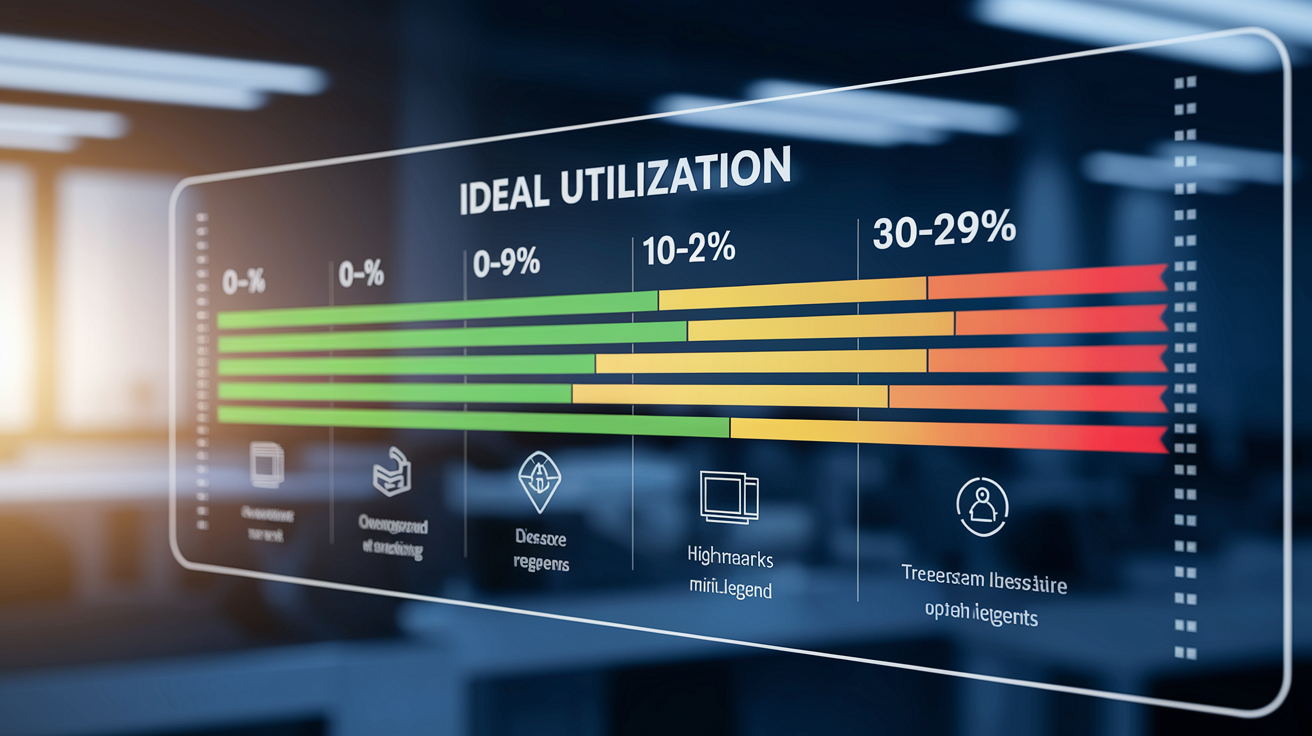
The most commonly cited threshold is 30 percent. Staying below that level is considered “good” and tends to keep your score from taking unnecessary hits. Many consumers with excellent credit scores, however, keep utilization in the single digits. Data from Q3 2024 showed the average overall credit utilization in the U.S. was 29 percent, landing just under the 30 percent marker but still higher than what top scoring borrowers typically carry.
Single digit utilization (anything from 1 percent to 9 percent) is common among people with FICO scores above 800. Using a small amount of your available credit each month shows lenders you’re an active borrower who doesn’t rely heavily on credit lines. Interestingly, 0 percent utilization can score slightly worse than 1 percent because scoring models prefer to see some activity. A report showing zero balances across all cards might suggest you’re not using credit at all, which provides less data for lenders to evaluate responsible usage.
A practical target for most people is around 10 percent. If you have $10,000 in total credit limits, aim to keep your combined balances under $1,000 at statement close. That gives you room to use your cards for everyday purchases, earn rewards if your cards offer them, and still report a low ratio to the credit bureaus.
| Percentage Range | Notes |
|---|---|
| 0–9% | Excellent. Common among highest scoring consumers. Shows light, controlled usage. |
| 10–29% | Good. Generally safe range. Staying closer to 10% is better than approaching 30%. |
| 30% and above | Higher risk signal. Scores often drop as utilization climbs above this threshold. |
How Credit Utilization Impacts Your Credit Score
Credit utilization falls under the “amounts owed” category in FICO scoring models, which typically accounts for around 20 to 30 percent of your overall score. That makes it one of the heaviest weighted factors after payment history. High utilization suggests to lenders that you’re stretched thin financially or relying too much on borrowed money. Low utilization signals the opposite: you have credit available but aren’t using most of it, which lenders interpret as lower risk.
Most scoring models pull the most recently reported balances when calculating your score. If your issuer reports a $2,000 balance on a $5,000 limit card this month, that 40 percent utilization is what the model sees. Even if you pay the balance to zero a week later. The score updates the next time your issuer reports a new balance, usually at the close of your next statement period. Newer scoring models, including FICO 10 T and VantageScore 4.0, also consider trended utilization, meaning they review your utilization over several months to spot patterns. A borrower who consistently carries high balances might score lower than someone whose utilization fluctuates month to month, even if both have the same current percentage.
The effect on your score can be immediate. Pay down a high balance before your statement closes, and your next reported utilization may drop, often leading to a score increase within 30 to 60 days. Conversely, maxing out a card can trigger a score drop as soon as that new balance gets reported. The impact isn’t permanent in most models. Utilization is a snapshot, not a long term record. Lower your utilization next month, and your score typically recovers, though trended models will still note the historical spike.
Scoring models interpret high utilization as elevated lending risk, which can lower approval odds and lead to higher interest rates on new credit. Low utilization improves your debt to credit ratio, a metric lenders review when deciding whether to extend additional credit or increase limits. Trended utilization tracking in newer models means a pattern of climbing balances can weigh more heavily than a single high utilization month, rewarding steady low usage over time.
When Credit Card Issuers Report Utilization and Why Timing Matters

Credit card issuers typically report your balance to the credit bureaus at or around the end of each statement period, not when your payment is due. Your statement closes, the issuer sends the balance and limit data to Equifax, Experian, and TransUnion, and then you receive your bill with a due date roughly three weeks later. That means the balance on your statement is usually the balance that shows up on your credit report, even if you pay it off in full before the due date.
If you want to report a lower utilization percentage, you need to pay down your balance before the statement closing date. Making a payment after the statement closes but before the due date will lower your next month’s balance, but it won’t change the number already reported to the bureaus. Timing your payments to land just before the statement period ends can ensure the bureaus see a smaller balance, which translates to a lower utilization ratio on your credit report.
- Find your statement closing date on your billing cycle information, usually listed on your monthly statement or in your online account dashboard.
- Make extra payments before that date if your current balance is higher than you want reported. Even a partial payment will lower the reported number.
- Monitor reported balances on your credit report to confirm the issuer is reporting the lower figure. Most issuers report within a few days of statement close, so your credit report should update within 30 to 45 days.
Strategies to Lower Your Credit Utilization

Lowering your credit utilization improves your score and makes you a more attractive borrower when applying for loans or new credit. The fastest way to drop your ratio is to pay down existing balances, but there are several complementary tactics that can increase your available credit or reduce the balances that get reported.
Pay balances before the statement closing date. Make multiple payments throughout the month so the balance sitting on your account when the statement period ends is lower. If you normally spend $1,500 on a $5,000 limit card, making a $750 payment mid cycle and another $750 before the statement closes can report a $0 balance instead of a 30 percent utilization.
Request credit limit increases. Call your issuer or submit a request online. A higher limit lowers your utilization percentage if your spending stays flat. Be aware that some issuers perform a hard inquiry when reviewing limit increase requests. A hard inquiry stays on your report for two years and may cause a small, temporary score dip.
Update your reported income with your card issuer. Issuers use income data to decide limit increases. If your income has risen since you opened the account, updating that information can improve your chances of a larger limit.
Consolidate revolving balances into an installment loan. A personal loan or home equity loan moves debt from revolving to installment. Your credit card balances drop to zero, your total revolving credit limit stays the same, and your utilization ratio falls. The installment loan doesn’t count toward utilization, though it does appear as a separate debt obligation.
Keep unused cards open. Closing a card removes its credit limit from your total available credit, which raises your utilization percentage if you carry balances on other cards. Even if you never use a card, keeping it open preserves that limit and helps your ratio.
Set card alerts for usage thresholds. Most issuers let you configure alerts that notify you when your balance reaches a certain percentage or dollar amount. Set an alert at 30 percent of your limit so you know when to make an extra payment before the statement closes.
Avoid opening new cards solely to manipulate utilization. A new card increases your total credit limit, which lowers utilization. However, the hard inquiry and the new account can temporarily lower your score, and adding credit you don’t need can lead to overspending. Open new accounts when they offer value beyond just a higher limit.
A useful rule of thumb: aim for total available credit equal to about ten times your typical monthly credit card spending. If you usually charge $500 per month, having $5,000 in total credit limits keeps you around 10 percent utilization when balances report. If you charge $2,000 per month, target $20,000 in total limits. This approach works only if you pay balances in full each month and avoid carrying debt that accrues interest.
Calculator Style Examples to Visualize Utilization

Walking through a few scenarios with real numbers makes it easier to see how small changes in balance or limit affect your utilization percentage. These examples mirror the calculations you’d do with a simple spreadsheet or a three card utilization calculator. Most online calculators let you enter balance and limit for up to three accounts, then display both per card percentages and an overall ratio.
Start with the two card example from earlier. Card A has a $500 balance and a $2,000 limit. Card B has a $500 balance and a $3,000 limit. Total balance is $1,000. Total limit is $5,000. Divide $1,000 by $5,000 to get 0.20, multiply by 100, and you land at 20 percent overall. Card A’s per card utilization is $500 ÷ $2,000 = 25 percent. Card B’s per card utilization is $500 ÷ $3,000 = 16.67 percent. Your overall ratio is healthy, and neither card is pushed above 30 percent individually.
Now consider the maxed card scenario. Card 1 has a $5,000 limit with a $5,000 balance (100 percent utilization). Card 2 has a $2,000 limit with a $2,000 balance (100 percent utilization). Card 3 has a $3,000 limit with a $0 balance (0 percent utilization). Your total balance is $7,000 across a total limit of $10,000, giving you 70 percent overall utilization. If you close Card 3 to avoid an annual fee, your total limit drops to $7,000 while your balance stays at $7,000, pushing your overall utilization to 100 percent. Closing an unused card in this situation makes your credit profile look riskier, even though your actual debt didn’t change.
| Card/Scenario | Balance / Limit | Utilization % |
|---|---|---|
| Single card (30% example) | $300 / $1,000 | 30% |
| Two cards combined (20% example) | $1,000 total / $5,000 total | 20% |
| Three cards, one closed (100% example) | $7,000 total / $7,000 total | 100% |
Final Words
Right away you learned a clear definition: credit utilization is the percent of revolving credit you’re using, calculated with the simple formula (credit used ÷ credit limit × 100). We walked through a 20% example, single‑card and multi‑card math, and why both per‑card and overall ratios matter.
You also saw benchmarks (under 30%, single digits often best), when issuers report balances, and practical fixes like paying before statement close or splitting payments.
If you still wonder what is credit utilization and how to calculate it, use the step‑by‑step examples and check your statement balances each month. Small, steady moves can lower utilization and boost your score.
FAQ
Q: Is 20% credit utilization too much?
A: A 20% credit utilization is generally fine; it sits under the common 30% guideline. Aim for single-digit utilization for top scores, and keep an eye on individual card balances.
Q: What is the credit card limit for $70,000 a year?
A: There’s no fixed credit card limit tied to a $70,000 salary; issuers set limits based on income, credit score, debt, and history. Starting limits commonly range from a few thousand to tens of thousands.
Q: How to calculate credit utilization?
A: To calculate credit utilization, divide total revolving balances by total credit limits, then multiply by 100. Example: 30% of a $500 limit equals $150 (0.30 × $500 = $150).