


What if ignoring interest rates is the smartest way to get out of debt?
The debt snowball lines up debts from smallest to largest and sends extra cash to the tiniest balance while you keep paying minimums on the rest.
It won’t always save the most money, but quick wins build confidence, make paying bills a habit, and often keep people from quitting.
Read on for a step-by-step setup, a real example, and a short checklist to see if snowball fits your budget and goals.
Core Explanation of the Method

The debt snowball method lines up your debts from smallest balance to largest, completely ignores interest rates, and throws all extra cash at the smallest debt while you keep paying minimums on everything else. Once that smallest debt hits zero, you take the full payment you were making on it and roll it into the next-smallest balance. That creates a growing “snowball” of payment power that picks up speed as you knock out each debt.
It works because humans need wins. Wiping out a $500 medical bill in two months feels like actual progress, even if that balance had zero interest and your $5,000 credit card at 24 percent is bleeding you dry every single day. That quick victory builds confidence, turns debt payoff into a habit, and proves the plan works before you get to the big scary balances that might make you give up.
Step-by-Step Breakdown of the Process
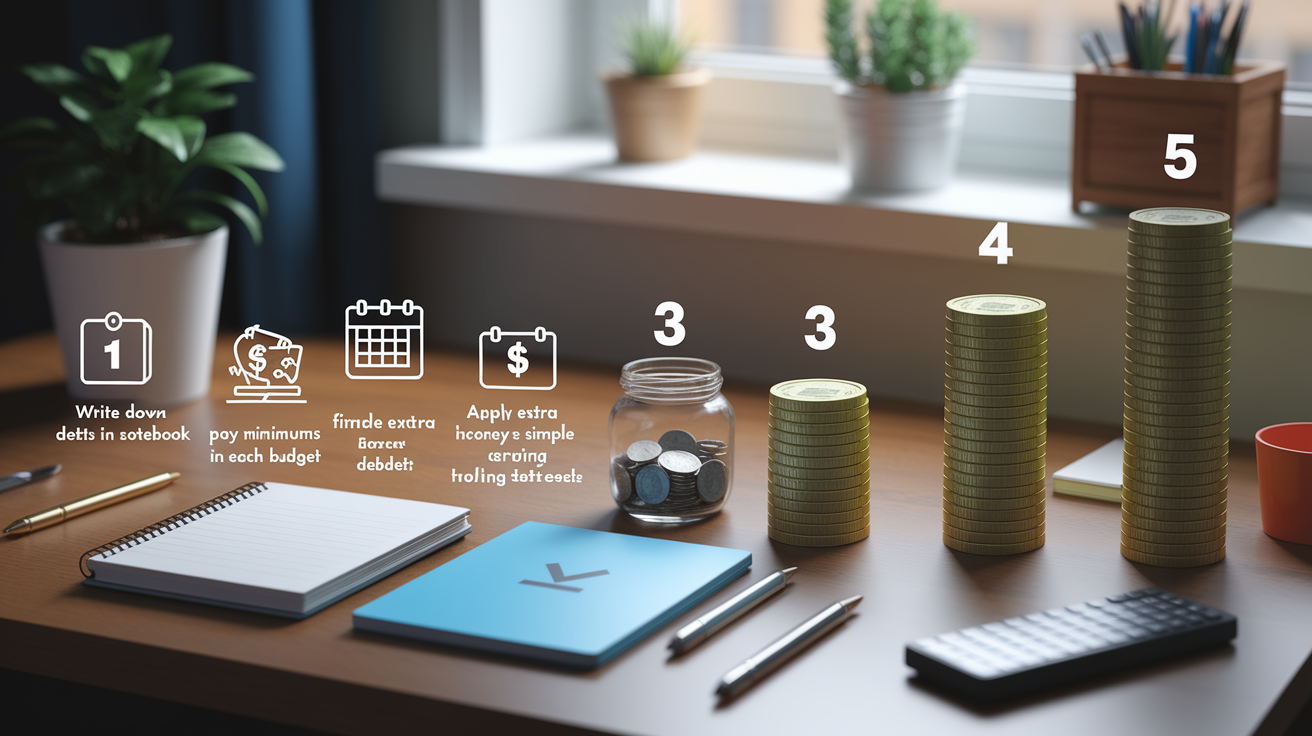
Here’s how you actually do this thing.
-
Write down every unsecured debt, smallest to largest. Skip your mortgage. For each one, note the creditor, current balance, interest rate, and minimum payment.
-
Pay the minimum on every debt, every month. Automate it if you can. Late fees and credit hits will wreck your plan faster than anything else.
-
Find extra money in your budget. Even $100 a month helps. More is better, but consistency matters more than the amount.
-
Send all extra cash to the smallest balance until it’s gone. Say your smallest debt is $800. Add your $150 extra to its $50 minimum payment, and you’ll clear it in four months.
-
Roll the freed payment into the next debt. Take that $200 you were paying on debt one and add it to the minimum on debt two. Keep going until everything’s paid off.
The trick is sticking to the order even when a high-interest balance tries to pull your attention. Don’t switch targets halfway through.
Simple Numerical Example

Let’s say you’ve got four debts: a $600 store card, a $1,200 medical bill, a $3,500 auto loan, and a $7,000 credit card. Your minimums total $285 per month, and you scraped together an extra $150 from your budget. With snowball, you pay minimums on the three bigger debts and throw $150 plus the store card’s $25 minimum at that $600 balance. You’ll kill it in about three and a half months.
| Debt Type | Balance | Minimum Payment | Snowball Order |
|---|---|---|---|
| Store card | $600 | $25 | 1st |
| Medical bill | $1,200 | $50 | 2nd |
| Auto loan | $3,500 | $110 | 3rd |
| Credit card | $7,000 | $100 | 4th |
Once the store card’s done, you roll that $175 payment into the medical bill’s $50 minimum. Now you’re paying $225 a month on that one, and it disappears in roughly five more months. Each payoff frees up another chunk of cash to attack the next balance. The momentum builds until the final debt gets crushed faster than if you’d spread your extra payments thin across all four.
Advantages and Drawbacks

Snowball gives you early wins that actually feel good. Crossing off a small debt in a couple months proves the plan’s working and shows you what being debt-free feels like. That can be serious fuel when your motivation tanks. It’s also dead simple to follow. No comparing interest rates or running spreadsheets. You list debts by size, start at the top, work down. That simplicity keeps people going, and finishing any plan beats optimizing one you quit.
The downside is cost. Ignoring interest rates means a $1,000 balance at 12 percent gets paid before a $5,000 balance at 26 percent, even though the bigger one’s racking up way more interest every month. Over time, that choice can cost you hundreds or a few thousand dollars compared to hitting high-rate debts first. Snowball also takes longer to knock down your most expensive debt, which means more months of brutal interest charges on balances that hurt the most. If you can stay motivated without quick wins, a different method might save you real money.
Comparison to the Debt Avalanche Method

Avalanche flips the whole thing. It orders debts by interest rate, highest to lowest, and sends extra payments to the most expensive debt first. Math-wise, avalanche cuts your total interest and shortens the timeline to debt-free, because you’re stopping the biggest bleed right away. A $4,000 balance at 28 percent costs you about $93 in interest every month. Killing that first saves cash that snowball leaves on the table.
Snowball works for people who need visible progress to keep going. People who’ve tried other plans and bailed, or who feel crushed by big balances and need proof they can win. Avalanche works for people who can wait for payoff, stay motivated by numbers, and want to pay the least total cost. If your highest-interest debt happens to be one of your smallest balances, the two methods overlap and you get quick wins plus maximum savings.
Practical Implementation Tips

Pull your most recent credit report first to make sure your debt list is complete and current. Missed accounts or wrong balances will wreck your timeline. Look at your last two months of spending to find non-essential stuff you can cut or dial back, then commit that freed cash to your snowball before it disappears into random spending.
Automate minimum payments on everything. Late fees and penalty APRs will cost you more than the interest you’re trying to dodge, and one missed payment can trash months of credit score progress.
Track your payoff where you can see it. Use a basic spreadsheet, a chart on the fridge, or a debt app that shows shrinking balances. Watching that smallest debt drop to zero keeps the momentum real.
Don’t use paid-off cards for new purchases while you’re still paying stuff down. The urge to “reward yourself” with freed-up credit can restart the whole mess. Treat a paid card like a closed account until everything’s gone.
Spend fifteen minutes a month reviewing your progress. Check balances, confirm payments posted, adjust next month’s extra payment if your budget shifted. Staying on top of it prevents surprises and keeps the plan moving.
Final Words
Pay the smallest balance first while keeping minimums on the rest — that’s the core move we walked through: definition, step-by-step process, a simple numbers example, the pros and cons, a comparison with avalanche, and practical tips like budgeting, automating, and tracking progress.
Now pick your smallest debt, choose an extra monthly amount you can sustain (even $25 helps), and set up automatic payments so wins show up without thinking.
Stick with the plan; the debt snowball method often turns early momentum into full payoff.
FAQ
Q: Does the debt snowball really work?
A: The debt snowball really works for many people because it clears smallest balances first to create quick wins and motivation, increasing consistency—though it can cost more interest than targeting high-rate debts first.
Q: How to pay $30,000 debt in one year?
A: To pay $30,000 debt in one year, set a $2,500 monthly target, cut expenses, boost income, consider refinancing or a low-fee balance transfer, and automate payments to ensure discipline and avoid missed payments.
Q: Is $20,000 in credit card debt a lot?
A: Whether $20,000 in credit card debt is a lot depends on your income and savings; it’s high for someone earning $50k (40% of income) but more manageable for higher earners—focus on interest rates and monthly payment strain.
Q: How long will it take to pay off $10,000 in credit card debt?
A: Paying off $10,000 in credit card debt depends on payment size and APR; at 18% APR, $200/month ≈ 7.8 years, $300/month ≈ 3.9 years, and $500/month ≈ 2 years.