


Think cash-back is free money from your card?
Think again.
For tax purposes the IRS usually treats cash rewards as a rebate, a discount on what you paid, not taxable income.
That means $200 back on $1,000 of spending reduces your cost to $800, not extra income to report.
There’s an important twist: when purchases are business expenses, rewards shrink what you can deduct.
This post explains how the IRS views rewards, gives simple examples, and shows the steps to keep your taxes correct.
How Cash Rewards Are Treated Under IRS “Rebate” Rules
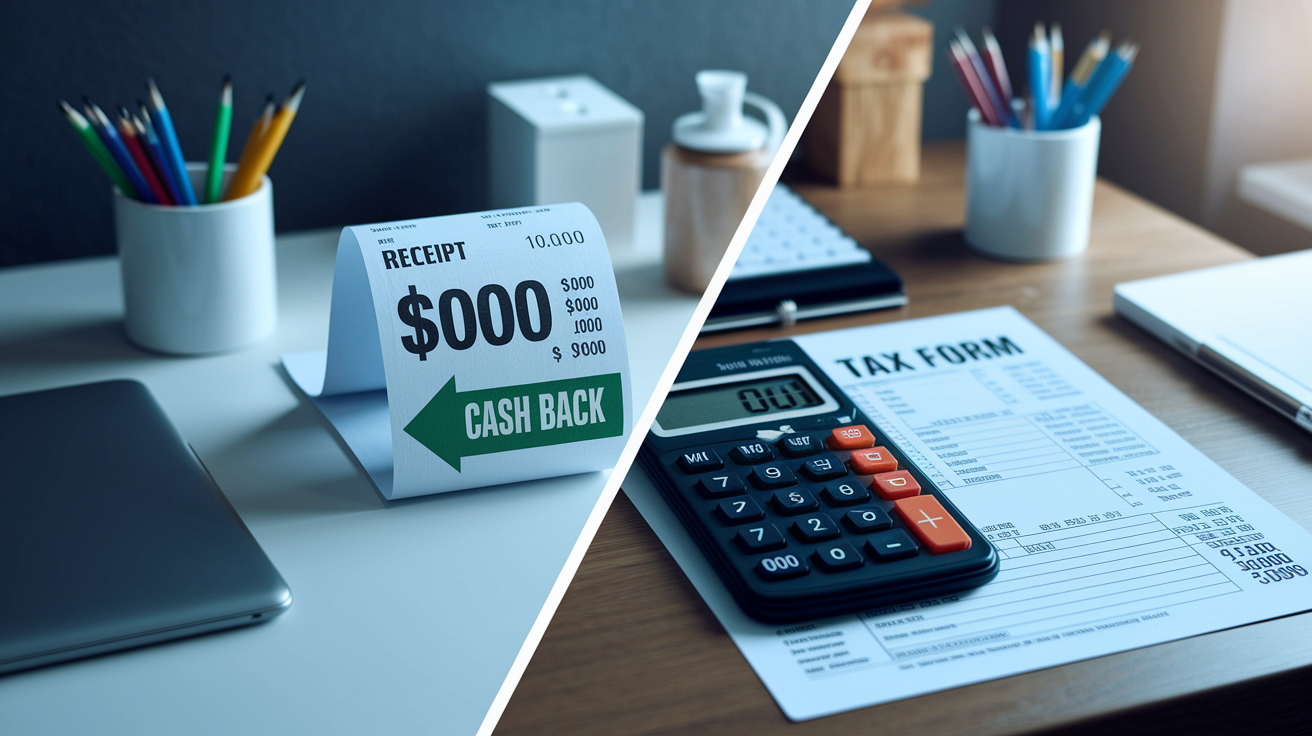
When you earn cash back from spending, the IRS looks at it as a discount on what you paid. Not income. You didn’t make money, you just paid less.
Here’s the math. Spend $1,000, get $200 back. Your actual cost? $800. That $200 doesn’t show up on your tax return as income.
This “cost basis” thing only matters if the purchase itself has tax consequences. For everyday stuff like groceries or gas, it doesn’t change anything. You can’t deduct personal spending anyway. But for business purchases, it changes what you’re allowed to write off. A business spends $1,000 on supplies and gets $200 cash back? The deductible expense is $800. The reward lowered what you actually paid, so it has to lower your deduction too.
Four examples:
Statement credit on a personal card: You spend $5,000 on travel and get a $500 credit. Net cost is $4,500. Travel’s a personal expense, so there’s no tax angle here. The $500 isn’t taxable.
Cash deposited to your bank: Spend $2,000 on home repairs, the card sends $60 to your checking account. Your real cost was $1,940. Still a personal expense. Can’t deduct it. The $60 isn’t taxable income.
Business purchase with a statement credit: Buy $3,000 in office equipment, earn $90 cash back as a credit. You deduct $2,910 on Schedule C, not the full $3,000. The $90 cut your cost, so it cuts your deduction.
Points turned into cash after business spending: Earn 50,000 points from $10,000 in business purchases, cash them out for $500. Your business cost was really $9,500. That’s what you deduct. The $500 is a rebate tied to those purchases, not separate income you have to report.
Final Words
We ran the numbers: statement credits and cash back directly lower a purchase’s cost — $1,000 minus $200 credit becomes $800 net. The post showed how that math differs for consumer versus business buys and walked through four concrete scenarios.
That cost-basis view keeps the tax logic simple: rewards tied to spending act as purchase adjustments, not extra income in most cases. Use the examples to reconcile receipts.
If you’re asking are cash rewards from credit cards taxable, the short answer is usually no when they offset purchases. Keep tracking credits per purchase, and you’ll stay on solid ground.
FAQ
Q: Do you pay taxes on reward money?
A: You generally don’t pay taxes on reward money when it’s a purchase-based rebate or statement credit because it reduces your purchase cost; standalone cash bonuses or interest-like rewards may be taxable, check 1099s.
Q: What is the most overlooked tax break?
A: The most overlooked tax break is above-the-line deductions—HSA contributions, educator expenses, and certain self-employment costs—because they lower adjusted gross income and can boost eligibility for other credits.
Q: What are the disadvantages of cashback rewards?
A: The disadvantages of cashback rewards are overspending to chase rewards, high interest costs if you carry a balance, annual or foreign transaction fees, and lower effective value on some purchases.
Q: What is the $600 cash rule in the IRS?
A: The $600 cash rule typically refers to reporting payments of $600 or more on Form 1099-NEC to nonemployee service providers; third-party payment (1099-K) thresholds are different, so verify current IRS rules.