


What if the quickest way to beat debt isn’t the smartest math?
It sounds controversial, but the debt snowball trades interest-rate neatness for fast wins that actually keep you going.
This post gives a full numeric walk-through — real dollar amounts, month-by-month payments, and a clear payoff timeline.
You’ll see how four debts totaling about $20,000 get knocked out in roughly 23 months by adding $500 a month from a side hustle and rolling each freed-up payment forward.
Read on for the exact payment schedule you can copy.
Full Numeric Walkthrough of the Debt Snowball Method Using a Real Example

Here’s a complete step-by-step numerical example showing how the debt snowball method works in practice, with real dollar amounts and a month-by-month timeline.
You’re starting with four debts totaling about $20,000: a $500 medical bill with a $50 monthly minimum, a $2,500 credit card at $63 minimum, a $7,000 car loan at $135 minimum, and a $10,000 student loan at $96 minimum. Your total minimum payments add up to $344 per month. You’ve picked up a side hustle bringing in an extra $500 monthly. Later in the plan you cut household expenses to free up another $100. That extra cash becomes your snowball payment, the amount you’ll roll forward into bigger debts as you knock out the small ones.
The payoff order starts with the $500 medical bill. In month 1, you put $50 minimum plus the entire $500 extra toward it, paying $550 total and eliminating it in one month. Next, you roll that $550 into the credit card along with its $63 minimum, creating a $613 monthly payment. The credit card’s gone in about four months. Then you roll $613 into the car loan with its $135 minimum, making a $748 payment each month. Car loan disappears in under nine months. Finally, you add the extra $100 from budget cuts to attack the student loan with $944 per month ($748 rolled payment + $96 minimum + $100 cuts). It’s paid off in about nine months. Total time from start to finish: roughly 23 months.
The snowball speeds up because each paid-off debt frees up its entire monthly payment to attack the next balance. The $550 that killed the medical bill becomes $613 when you add the credit card’s minimum. That $613 becomes $748 when you add the car loan’s minimum. By the time you reach the largest debt, you’re throwing nearly $1,000 per month at it. More than triple your original extra payment.
| Month | Total Payment Applied | Debt Targeted | New Balance |
|---|---|---|---|
| 1 | $550 | $500 Medical Bill | $0 (paid off) |
| 5 | $613 | $2,500 Credit Card | $0 (paid off) |
| 14 | $748 | $7,000 Car Loan | $0 (paid off) |
| 23 | $944 | $10,000 Student Loan | $0 (paid off) |
| 23 | All Debts | All Debts | $0 (debt-free) |
Prioritizing Debts by Balance to Start the Snowball

The debt snowball method requires you to list every debt from smallest balance to largest, ignoring interest rates entirely. That ordering’s critical. It’s how the method creates quick wins that keep you motivated. The smallest balance gets attacked first because it disappears fastest, giving you a concrete victory early in the plan. You’re trading mathematical perfection (paying highest-rate debts first) for psychological momentum.
In the example above, the debts line up like this: $500 medical, $2,500 credit card, $7,000 car loan, $10,000 student loan. Notice we don’t mention APRs or interest charges. The balance is the only number that matters when you’re setting up your payoff order. This approach only applies to non-mortgage consumer debts. Credit cards, medical bills, car loans, student loans, personal loans. Your mortgage stays out of the snowball. You keep making the regular payment and handle it separately.
To list your debts correctly:
Pull the current balance for every consumer debt (exclude your mortgage). Write each balance on a simple list or spreadsheet. Sort the list from smallest dollar amount to largest dollar amount. Ignore interest rates, monthly minimums, and original loan amounts. Double check that the smallest balance is at the top and the largest is at the bottom.
Minimum Payments and Extra Cash: How the Snowball Actually Grows

Minimum payments are the floor. The amount you’re required to send each month to keep the account current. In the four-debt example, those minimums are $50, $63, $135, and $96. You keep making every single minimum payment, every single month, on every debt except the one you’re attacking. That keeps all your accounts in good standing and prevents late fees, penalty APRs, and credit damage.
The snowball grows when you add extra money to the smallest debt’s minimum payment. The example uses $500 monthly from a side hustle. That $500 gets added to the $50 medical-bill minimum, creating a $550 total payment in month 1. After the medical bill’s gone, that same $550 rolls forward and combines with the credit card’s $63 minimum, making a $613 payment. Later in the plan, cutting household expenses frees up another $100, which gets added once the car loan is paid off.
Each time a debt’s eliminated, the monthly payment you were making on it doesn’t disappear. It rolls into the next debt on the list. The $550 that wiped out the medical bill becomes $613 on the credit card. The $613 becomes $748 on the car loan. The $748 becomes $944 on the student loan once you add the extra $100 in budget cuts. That compounding effect is the snowball. The payment amounts keep stacking on top of each other, turning a modest $500 in extra monthly income into a nearly $1,000-per-month debt destroyer by the time you reach the final balance.
Visualizing the Snowball Effect with a Simple Payment Table

A month-by-month table makes it easier to see how the snowball builds momentum over time and how quickly your total remaining debt drops once the first few accounts are gone.
| Month | Smallest Debt Balance | Payment Applied | Cumulative Snowball Amount | Remaining Total Debt |
|---|---|---|---|---|
| 1 | $500 | $550 | $550 | $19,500 |
| 2 | $2,500 | $613 | $613 | $19,387 |
| 5 | $7,000 | $748 | $748 | $16,752 |
| 9 | $7,000 | $748 | $748 | $13,760 |
| 14 | $10,000 | $944 | $944 | $9,280 |
| 18 | $10,000 | $944 | $944 | $5,504 |
| 23 | $0 | $944 | $944 | $0 |
Comparing Snowball vs Avalanche Using the Same Numbers
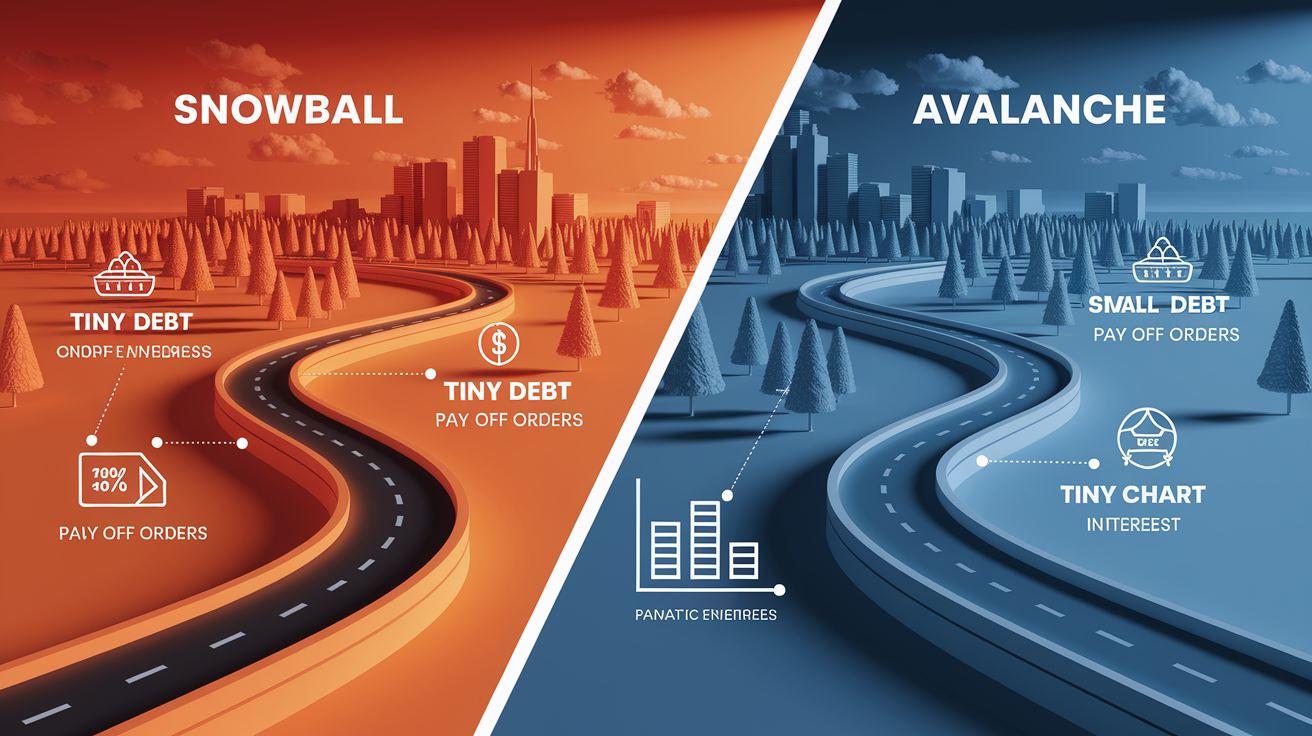
The debt avalanche method prioritizes debts by interest rate, attacking the highest-rate balance first to cut total interest paid. Using the same four debts from the snowball example, let’s assign hypothetical interest rates to show the difference: 17 percent on the credit card, 9 percent on the car loan, 5 percent on the student loan, and 0 percent on the medical bill (many medical bills carry no interest if paid within a certain window).
Under the avalanche method, you’d pay the credit card first (highest rate), then the car loan, then the student loan, and finally the medical bill. That order saves you the most money in interest charges over the life of the payoff. But it also means your first victory doesn’t come until the $2,500 credit card is gone. About four months in, assuming the same $500 extra payment. Under the snowball, you get a win in month 1 when the $500 medical bill disappears.
| Method | Payoff Order | Estimated Interest Paid | Motivation Level |
|---|---|---|---|
| Snowball | Medical → Credit Card → Car → Student Loan | Higher (low-rate debts paid last) | High (quick early wins) |
| Avalanche | Credit Card → Car → Student Loan → Medical | Lower (high-rate debts paid first) | Lower (first win takes longer) |
The snowball method acknowledges that personal finance is roughly 80 percent behavior and 20 percent head knowledge. If paying an extra $200 in interest over two years keeps you motivated enough to stay on the plan and actually finish, that’s a reasonable tradeoff. The avalanche is mathematically perfect. But only if you stick with it. A plan you follow beats a perfect plan you abandon.
How Budget Adjustments and Side Income Change the Snowball Timeline

Small increases in your monthly extra payment can cut months off your payoff timeline. Using the same $20,000 in debt from the example, here’s how different levels of extra income change the total time to debt-free.
With an extra $50 per month beyond minimums, you’d pay off the four debts in roughly 38 months. With an extra $200 per month, the timeline drops to about 28 months. With an extra $600 per month (combining side income, budget cuts, and maybe a tax refund or bonus applied monthly), you’d be debt-free in around 18 months. The snowball effect compounds faster when you have more cash to roll forward each time a debt’s eliminated.
Side income makes a real difference. In the base example, the $500 monthly side hustle cut the payoff time nearly in half compared to paying only minimums. If you can add another $100 by negotiating your cell phone bill, canceling unused subscriptions, or selling items you don’t need, that $100 rolls into every subsequent debt once the first balance is gone. A $100 boost today becomes part of a $600+ payment later in the plan.
Emergency fund positioning matters here. The debt snowball typically assumes you’ve set aside a small starter emergency fund first, often $1,000, before attacking debt aggressively. That cushion keeps you from reaching for a credit card when the car needs a repair or the water heater fails. Without it, one unexpected expense can derail months of progress.
Motivation and Psychological Momentum in a Numeric Snowball Example

The snowball method works because it creates visible progress fast. Paying off a $500 medical bill in one month feels like a real win, even if it’s the smallest balance on your list. That victory builds confidence and proves the plan works, which keeps you engaged when the next debt takes longer to clear.
In the four-debt example, you get two wins in the first five months: the medical bill in month 1 and the credit card by month 5. Those early milestones generate momentum that carries you through the longer payoff periods on the car loan and student loan. By the time you’re halfway through the plan, you’ve already eliminated two accounts and freed up $613 per month to attack the next balance. That psychological boost is why the method emphasizes behavior over pure math. It’s designed to keep you moving forward even when the numbers feel overwhelming at the start.
Final Words
A complete step-by-step numerical example follows.
Start in the action: pay the $500 medical bill first, then tackle the $2,500 credit card, the $7,000 car loan, and the $10,000 student loan while adding a $500 side‑gig and later $100 in cuts. Your rolled payments grow from $550 → $613 → $748 → $944 and clear every balance in about 23 months.
This debt snowball method example with numbers shows how quick wins and payment rollovers build momentum, not magic. Pick one payment to boost this week and you’ll be surprised how fast the snowball grows.
FAQ
Q: What is an example of the debt snowball method?
A: An example of the debt snowball method is starting with the $500 medical bill at $50 minimum, add a $500 side‑hustle payment to clear it in one month, then roll the $550 into the $2,500 credit card next.
Q: What is the 15 3 payment trick?
A: The 15 3 payment trick is a short-term acceleration tactic: boost monthly payments by about 15% for three months to cut principal faster, reduce interest, and build payoff momentum—confirm you can cover the extra cash flow.
Q: Is $20,000 in credit card debt a lot?
A: Twenty thousand dollars in credit card debt is large for most people; at 20% APR you’d pay roughly $333 a month just in interest, so prioritize larger payments, lower-rate options, or balance transfers.
Q: How can I pay off $10,000 in debt quickly?
A: To pay off $10,000 quickly, choose snowball or avalanche, free up $100–$500 monthly by cutting expenses or adding side income, and apply extra payments—$600/month clears $10k in about 17 months ignoring interest.