


Controversial: targeting your smallest debts first can be smarter than chasing high interest—because people stick with it longer.
If you struggle to keep momentum, a clear, printable plan makes the difference.
This post gives you a free Debt Snowball Method PDF: a ready-to-print template and tracker that lists debts smallest-to-largest, records monthly payments, calculates rollovers, and marks milestones.
Use it to track progress, avoid confusion when debts disappear, and turn small wins into steady payoff momentum.
Downloadable Debt Snowball Method PDF Essentials

A debt snowball method PDF is basically a printable toolkit that turns a popular debt payoff strategy into something you can actually use with pen and paper. Inside, you’ll find worksheets, trackers, and step-by-step directions that help you list your debts from smallest to largest, pay minimums on everything except that tiniest balance, and throw every spare dollar at it until it’s gone. Once you knock out the smallest debt, you roll that full payment into the next one. The idea? Momentum builds like a snowball rolling downhill.
Most debt snowball PDFs are built around a handful of pieces that fit together. There’s usually a debt list worksheet where you write down every balance and its minimum payment. You’ll see a monthly payoff tracker with boxes you can check off as you make payments. There’s a rollover payment template showing exactly how much to throw at the next debt once you’ve cleared one. Instructions walk you through the whole sequence. Some PDFs toss in behavioral tips to keep you motivated and a pause-condition checklist that tells you when to pump the brakes temporarily if something goes sideways.
Here’s what a solid debt snowball PDF usually includes:
- Debt list worksheet (sorted smallest balance to largest)
- Monthly payment tracker with check-off boxes for each debt
- Payment rollover template showing new monthly amounts after each payoff
- Instructions with real example numbers
- Behavioral motivation tips and milestone markers
- Pause-condition checklist (five situations when to hold off or slow down)
Each part does something specific. The list keeps things in order. The tracker shows you’re making progress. The rollover template stops you from getting confused when a debt disappears and you need to recalculate. Instructions keep you from wandering off course. Behavioral tips prevent burnout. The pause checklist protects you from making things worse during a crisis.
How the Debt Snowball Method Works (PDF-Ready Explanation)

The debt snowball method follows a five-step loop that you repeat until every non-mortgage debt is paid. The focus is always smallest balance first, not lowest interest rate first. That’s intentional. Personal finance is often described as 80 percent behavior and 20 percent head knowledge, and the snowball method is built for behavior change, not pure math optimization.
Each step is designed to build visible momentum. When you knock out a small debt in one or two months, you feel progress. That feeling powers the next payoff. As each debt disappears, the amount you apply to the next one grows larger, speeding up the timeline and reinforcing your commitment.
Here’s the exact sequence your debt snowball PDF will walk you through:
-
List all your debts from smallest balance to largest. Ignore interest rates. A $300 medical bill goes before a $5,000 credit card, even if the card charges 28 percent.
-
Make minimum payments on every debt except the smallest. You’re protecting your credit and avoiding late fees, but you’re not accelerating those debts yet.
-
Apply every extra dollar you can find to the smallest debt. Side hustle income, budget cuts, tax refunds, birthday cash. Everything goes to that one balance until it’s paid.
-
Once the smallest debt is paid, roll that entire payment into the next smallest debt. If you were paying $150 total on the smallest debt and $50 minimum on the next one, you now pay $200 on the second debt.
-
Repeat until all consumer debts are paid. Each payoff makes the snowball bigger, and the timeline for each remaining debt gets shorter.
The method works because it turns abstract progress into visible wins. Paying off a $400 bill in six weeks feels real. That feeling keeps you going when the $8,000 car loan still looms.
Debt Snowball Worksheet PDF Components and How to Use Them
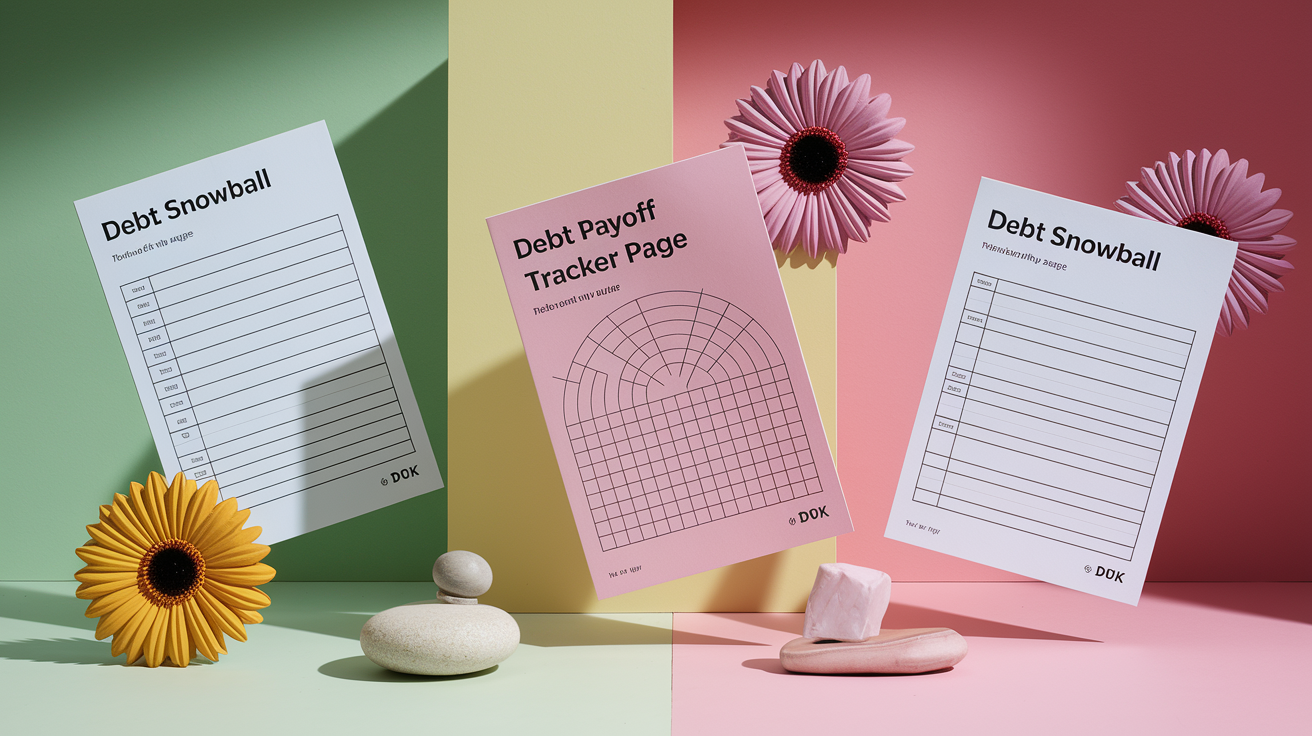
A well-designed debt snowball worksheet PDF typically includes three distinct pages, each with a clear purpose. Page one is the debt list and payments table, where you write every debt from smallest to largest, record the minimum payment, note any extra payment applied that month, and check off each month as you make progress. Page two is a payoff tracker that includes space for goals, a running tally of how much you’ve paid, and a visual progress marker showing movement toward complete debt freedom. Page three is the rollover worksheet, where you calculate new monthly payment amounts each time a debt is paid and freed up cash moves to the next balance.
Each worksheet prevents confusion and keeps momentum visible. The debt list keeps the order locked in. Once you sort smallest to largest, you don’t re-sort based on interest rate changes or new balances. The tracker shows how many debts you’ve eliminated and how much total debt remains. The rollover worksheet does the math for you so you never wonder how much to pay now that the credit card is gone.
Most PDFs include fields for the debt name (medical bill, Visa, car loan), current balance, minimum monthly payment, extra payment applied this month, and a row of boxes to check off as each month’s payment is made. Some also include a notes column for tracking payoff dates, interest rate changes, or one-time windfalls applied to a specific debt.
The typical three-page structure looks like this:
- Debt Snowball Payments page — List all debts, track monthly payments, check off each payment as made
- Debt Payoff Tracker page — Set payoff goals, track cumulative progress, celebrate milestones
- Debt Snowball Worksheet page — Calculate rollover amounts, update payment totals after each payoff, plan next steps
Print all three pages at the start. Fill in the debt list once. Update the tracker monthly. Recalculate the rollover worksheet each time a debt is paid. Keep all three pages in one folder or binder so you can see your full plan at a glance.
Debt Snowball Example Schedule PDF (Filled-In Sample)

A filled-in debt snowball schedule shows exactly how payments flow, how balances shrink, and how the snowball grows over time. The sample below uses four common debts (a small medical bill, a mid-sized credit card, a car loan, and a student loan) and tracks how a $500 monthly side hustle accelerates the payoff.
In this example, you list the debts smallest to largest: $500 medical bill, $2,500 credit card, $7,000 car loan, $10,000 student loan. Minimum payments are $50, $63, $135, and $96. You add $500 extra income every month from a weekend side gig. That $500 goes entirely to the smallest debt first, then rolls into the next debt once the first is paid.
| Debt Name | Balance | Minimum Payment | Extra Applied | Estimated Payoff Month |
|---|---|---|---|---|
| Medical bill | $500 | $50 | $500 (side hustle) | Month 1 |
| Credit card | $2,500 | $63 | $550 (min $50 + side hustle $500, rolled from medical bill) | Month 5 (4 months after medical bill paid) |
| Car loan | $7,000 | $135 | $613 (min $63 + rollover $550, from credit card payoff) | Month 14 (9 months after credit card paid) |
| Student loan | $10,000 | $96 | $748 (min $135 + rollover $613, from car loan payoff); later increased to $944 with an extra $100/month budget cut | Month 23 (9 months after car loan paid, boosted by spending reduction) |
In this scenario, you pay off $20,000 in under 24 months by maintaining the $500 side hustle, sticking to minimums on all other debts, and adding one more $100 per month spending cut near the end. The medical bill disappears in one month. The credit card takes four more months. The car loan takes another nine. The student loan, now receiving nearly $950 per month, is cleared in about nine additional months. Each payoff makes the next one faster because the snowball keeps growing.
Snowball vs Avalanche PDF Comparison

The debt snowball method is one of two popular payoff strategies. The other is the debt avalanche, which targets the highest interest debt first instead of the smallest balance. Both methods require you to make minimum payments on all debts except one, but they differ in which debt gets the extra cash.
The snowball prioritizes quick wins and sustained motivation. Paying off a $400 balance in a few weeks feels good, and that feeling powers the next payoff. The avalanche prioritizes total interest savings. Paying off a 27 percent APR card before a 6 percent car loan saves more money over time, but the first payoff might take months longer. For many people, the extra interest saved in an avalanche plan is less valuable than the motivation gained from early snowball wins.
| Method | Key Benefit |
|---|---|
| Debt Snowball (smallest balance first) | Faster visible wins, stronger motivation, simpler to maintain, better for people who need early momentum to stay committed |
| Debt Avalanche (highest interest first) | Lower total interest paid over the life of all debts, mathematically optimal, better for people with high discipline and patience |
If your debts have similar interest rates, the snowball and avalanche plans will produce nearly identical results. If your smallest debt also carries the highest rate, the two methods become the same. The snowball works best when motivation is your limiting factor. The avalanche works best when math is your priority and you can wait months for the first win.
Budgeting and Cash Flow Tools to Support Your Debt Snowball PDF

The debt snowball only works if you consistently apply extra money to the smallest debt. That extra money comes from one place: margin in your monthly budget. A debt snowball PDF is most effective when paired with a simple monthly budget worksheet that tracks income, fixed expenses, variable spending, and leftover cash available for debt payoff.
Most people find margin by cutting discretionary spending (eating out less, pausing subscriptions, shopping secondhand), adding new income (side gigs, freelance work, selling unused items), or temporarily reducing other financial goals (pausing retirement contributions, delaying a vacation fund). The key is making the cuts sustainable. A $500 monthly reduction that burns you out in two months is worse than a $200 reduction you can maintain for two years.
A complete debt snowball PDF package often includes a monthly cash flow template with line items for rent or mortgage, utilities, groceries, transportation, insurance, debt minimums, and discretionary spending. You fill in actual amounts, subtract total expenses from total income, and see what’s left. That leftover amount becomes your snowball payment. If there’s no margin, the worksheet forces an honest conversation. Either income needs to go up, or spending needs to come down, or both. Without margin, the snowball can’t roll.
Tracking Motivation and Behavior (Printable Progress Charts)

Debt payoff is a long game, and motivation fades without visible progress. Printable progress charts turn abstract numbers into something you can see changing week by week. A progress bar that fills in as you pay off each debt, a thermometer chart that colors in from bottom to top as your total debt shrinks, or a simple checklist that lets you cross off each balance as it hits zero. These tools work because they make incremental progress feel real.
The behavioral principle behind progress tracking is simple. Quick wins reinforce continued effort. When you pay off the $500 medical bill in month one and fill in the first box on your tracker, you see proof that the plan works. When you check off the second debt four months later, you’ve built momentum. By the time you’re halfway through the list, the habit is ingrained and the finish line is visible.
Here are five types of printable trackers that work well inside a debt snowball PDF:
- Debt payoff checklist — One box per debt; check it off when the balance hits zero
- Progress bar or thermometer — Shade in sections as total debt decreases
- Monthly payment tracker — A calendar grid with a box for each debt payment made that month
- Milestone chart — Mark every $1,000 or $5,000 paid with a sticker, stamp, or colored marker
- Rollover celebration page — Space to note the date each debt is paid and how much freed up cash now rolls to the next debt
Pick one or two trackers that feel motivating to you. Update them monthly, or weekly if that helps. Keep them visible. Taped to the fridge, clipped inside your budget binder, or stored in a folder you review every payday. The goal is to make progress impossible to ignore.
Pausing or Adjusting the Debt Snowball (PDF Decision Guide)
The debt snowball works best when life is stable. But life isn’t always stable, and there are specific situations where pausing or slowing the plan is the right move. Pushing forward with aggressive debt payments during a financial crisis can leave you with no cash cushion, forcing you to rely on credit cards for emergencies. Which defeats the purpose of the snowball.
A pause doesn’t mean failure. It means protecting the progress you’ve already made while you handle a bigger priority. Once the crisis passes, you restart the snowball exactly where you left off. The debts don’t disappear during the pause, but they also don’t spiral out of control if you continue making minimums.
Most debt snowball PDFs include a decision checklist that flags when to pause. If any of the following five scenarios apply, temporarily stop extra payments and redirect that cash to an emergency fund, medical costs, or basic living expenses:
- Unexpected job loss or significant income reduction — Protect your ability to cover rent, utilities, and food before accelerating debt payoff
- Health crisis for you or an immediate family member — Medical bills and care costs take priority over credit card balances
- Major life change such as divorce, separation, or relocation — Stabilize your new baseline expenses and income before resuming aggressive payoff
- Outstanding IRS bill or tax debt — The IRS has more collection power than credit card companies; resolve tax debt first
- Having a baby or adopting a child — New childcare costs, medical expenses, and lost income during parental leave require cash reserves
If one of these applies, shift to minimum payments only and build a small emergency buffer of $500 to $1,000. Once the situation stabilizes, restart the snowball. You’ll lose some time, but you won’t lose the progress already made, and you won’t end up deeper in debt because you had no cash for an emergency.
Advanced Snowball Strategies (PDF Add-On Templates)
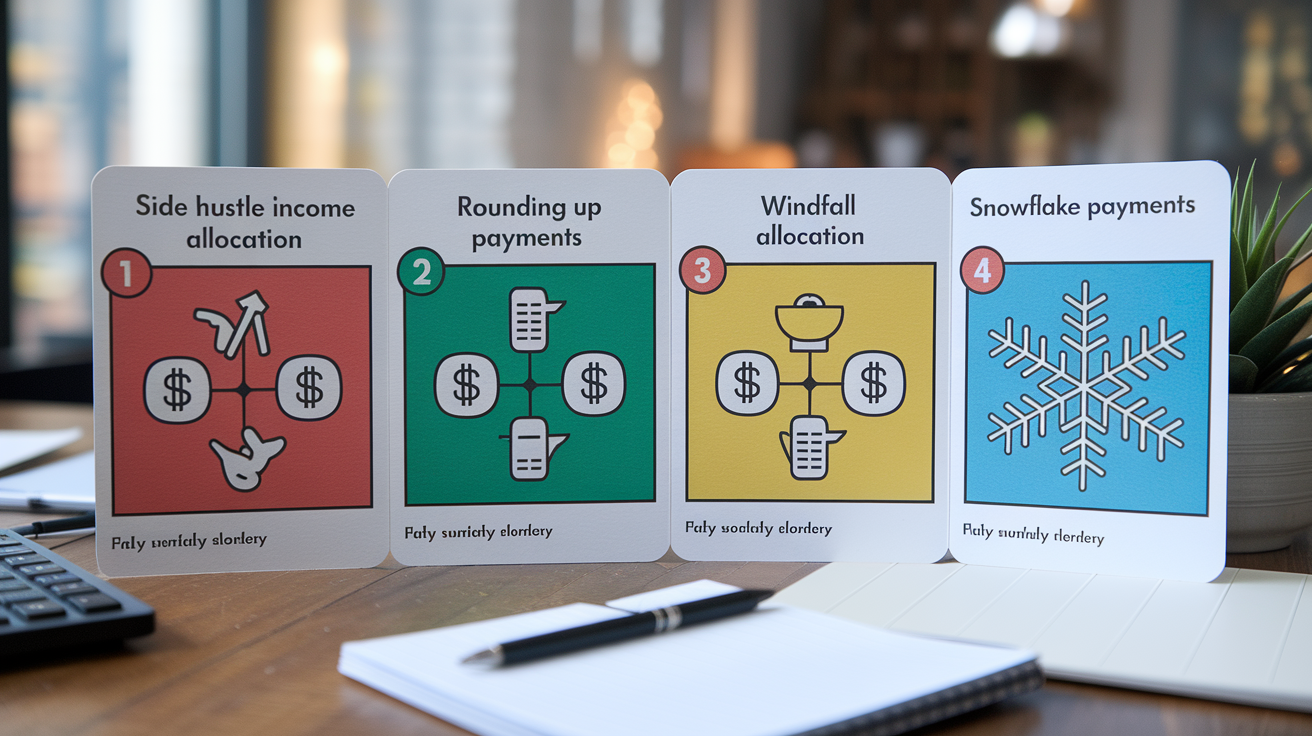
Once you’ve mastered the basic debt snowball, advanced strategies can shorten the timeline and increase total debt paid. These strategies involve finding extra cash beyond your normal budget, applying one-time windfalls strategically, and combining small “snowflake” payments with your main snowball plan. Premium or expanded debt snowball PDFs often include templates and worksheets that guide these tactics.
The most effective advanced strategies focus on increasing the monthly extra payment without creating unsustainable lifestyle cuts. A $500 side hustle that you can maintain for 18 months will eliminate more debt than a $1,000 spending cut that burns you out in three months. Similarly, rounding up every debt payment to the nearest $50 or $100 creates steady incremental progress without requiring a formal budget overhaul.
Here are four advanced tactics that fit naturally into a debt snowball PDF:
-
Side hustle income allocation plan — Track every dollar earned from freelance work, weekend gigs, or selling items; apply 100% to the smallest debt; include a worksheet that logs hustle income separately from regular paychecks.
-
Rounding up payment strategy — Always round your snowball payment to the next $25, $50, or $100 increment; if your calculated payment is $347, pay $350 or $400; the extra few dollars compound quickly over multiple debts.
-
Windfall allocation worksheet — Plan in advance how to split tax refunds, bonuses, gifts, or other one-time cash; common split: 50% to smallest debt, 25% to emergency fund, 25% to a small reward or necessary expense.
-
Snowflake payments — Apply small, irregular amounts to the smallest debt throughout the month (rebate checks, cash back rewards, side gig tips); track each snowflake payment separately and add them to your regular monthly snowball amount.
For example, if your base snowball payment is $400 per month and you add a $500 side hustle plus $150 in snowflake payments (a $50 rebate, $60 in credit card cash back, $40 from selling clothes online), your total monthly payment becomes $1,050. That acceleration can cut months off a payoff timeline. An advanced PDF template tracks the base payment, side hustle income, and snowflake total separately, then sums them into one monthly amount to apply to the current target debt. This level of detail prevents confusion and ensures every extra dollar is accounted for and applied correctly.
Final Words
Grab the printable kit and start listing your debts smallest to largest—use the worksheet, tracker, and payoff schedule to map a clear plan.
This article gives a downloadable debt snowball PDF with step-by-step instructions, a filled example schedule, budgeting tools to find extra margin, motivation trackers, a pause checklist, and advanced templates to speed payoff.
Print the debt snowball method pdf, set one small extra payment this month, and watch momentum build. You’re closer than you think.
FAQ
Q: What does the downloadable debt snowball PDF include?
A: The downloadable debt snowball PDF includes a debt list worksheet, step-by-step instructions, monthly payoff tracker, rollover payment template, behavioral tips, and a pause-condition checklist.
Q: How does the debt snowball method work?
A: The debt snowball method works by listing debts smallest to largest, paying minimums on all except the smallest, applying extra money to the smallest, then rolling those payments into the next debt.
Q: How do I use the worksheet fields in the PDF?
A: You use the worksheet fields by recording balances, minimum payments, extra payments and monthly check-off boxes, updating those each month until the 100% payoff marker is reached.
Q: Can you show an example payoff schedule with numbers?
A: An example payoff schedule shows $500 medical ($50 min) paid in 1 month, $2,500 credit card ($63) in 4 months, $7,000 car loan ($135) under 9 months, $10,000 student loan about 9 months.
Q: What’s the difference between the snowball and avalanche methods?
A: The difference is snowball targets smallest balances first for quick wins; avalanche targets highest interest first to minimize total interest. Snowball boosts motivation, avalanche often saves more money overall.
Q: How do I find extra cash to speed up my snowball?
A: You find extra cash by trimming variable spending, canceling unused subscriptions, using budgeting apps, rounding up payments, or adding a side hustle—an extra $500/month shortens payoff dramatically.
Q: How should I track motivation and progress with the printable PDF?
A: You track motivation by using printable progress bars, color-coded charts, monthly check-offs, milestone rewards, and visual 100% payoff markers to see momentum and celebrate each debt closed.
Q: When should I pause or adjust the debt snowball plan?
A: You should pause or adjust the plan for major events like job loss, health crisis, significant life changes, an unexpected tax bill, or a new baby; maintain an emergency buffer before resuming.
Q: What advanced strategies can speed up my snowball?
A: Advanced strategies include combining snowflakes (small extra payments), rounding up payments, directing side-hustle income or windfalls to principal, and using rollover templates to immediately boost the next payment.
Q: How many pages does a typical debt snowball PDF have and what are they?
A: A typical debt snowball PDF is a 3-page kit: a debt list and payments table, a payoff tracker with progress bars, and a monthly ledger that includes rollover payment templates.