


Think paying a collection will instantly fix your credit?
It won’t always.
A single collection can shave 100 points or more because payment history is about 35 to 40 percent of your FICO score.
Which scoring model a lender uses changes everything.
This guide shows the fastest, safest moves: validate debts, dispute errors, negotiate pay-for-delete or strategic settlements, and add positive tradelines so new good history builds while old negatives age out.
Follow these steps and you can raise your FICO score faster without costly mistakes.
Priority Actions to Raise FICO Score After Collections Fast

Collections can tank your FICO score by 100 points or more the second they show up. Payment history drives 35 to 40 percent of most credit scoring models, so when a collection hits your file, it hits hard. But there’s good news. Newer scoring models like FICO 9, FICO 10, FICO 10T, VantageScore 3.0, and VantageScore 4.0 don’t count paid collections at all. Pay the debt, and if your lender uses one of those models, your score can jump. FICO 8 is a different story. It’s still the most common model out there, and under FICO 8, paying a collection over $100 doesn’t move your score one bit. The account stays on your report either way. Collections stick around for seven years from the date of your first missed payment, not when it went to collections or when you paid it. Acting fast to dispute errors, validate debts, and negotiate removal gives you the longest window to recover.
You can’t just throw money at collections and hope for the best. If you pay without validating first, you might confirm a debt that isn’t even yours or restart the statute of limitations in some states. Dispute an inaccurate item and win? It’s gone completely. No seven year wait. Negotiate pay for delete in writing? You can potentially wipe a legitimate collection off your report before it ages off naturally. Knowing which moves work under which scoring models lets you match your actions to your goals, whether that’s mortgage approval, a car loan, or a credit card with a decent APR.
Here’s how to maximize score gains while protecting yourself:
Validate the debt before you do anything else. Request written validation from the collector within 30 days of first contact. Make sure the debt is yours, the amount is right, and the collector has legal standing. If they can’t validate, it shouldn’t be on your report.
Dispute inaccurate data with all three bureaus immediately. File disputes online or by certified mail, attach supporting documents, and expect resolution in 30 to 45 days. Inaccurate collections get removed, not just marked “disputed.”
Negotiate pay for delete when you can. Ask the collector to delete the tradeline entirely if you pay. Get it in writing before you send anything. Success varies, but it’s worth asking on every account.
Settle or pay high impact accounts strategically. Under newer models, paying collections raises scores. Focus on the biggest balances or accounts most likely to trigger lawsuits, then tackle smaller debts as budget allows.
Remove misreported medical collections under new bureau rules. Medical collections under $500 and paid medical collections can’t appear on credit reports. If you see them, dispute right away and cite the reporting restriction.
Start adding positive tradelines the same week you address collections. Open a secured credit card, report your rent and utility payments, or become an authorized user on a well managed account. Layer on time payment history while old negatives age out.
Understanding How Collection Accounts Affect Your FICO Score
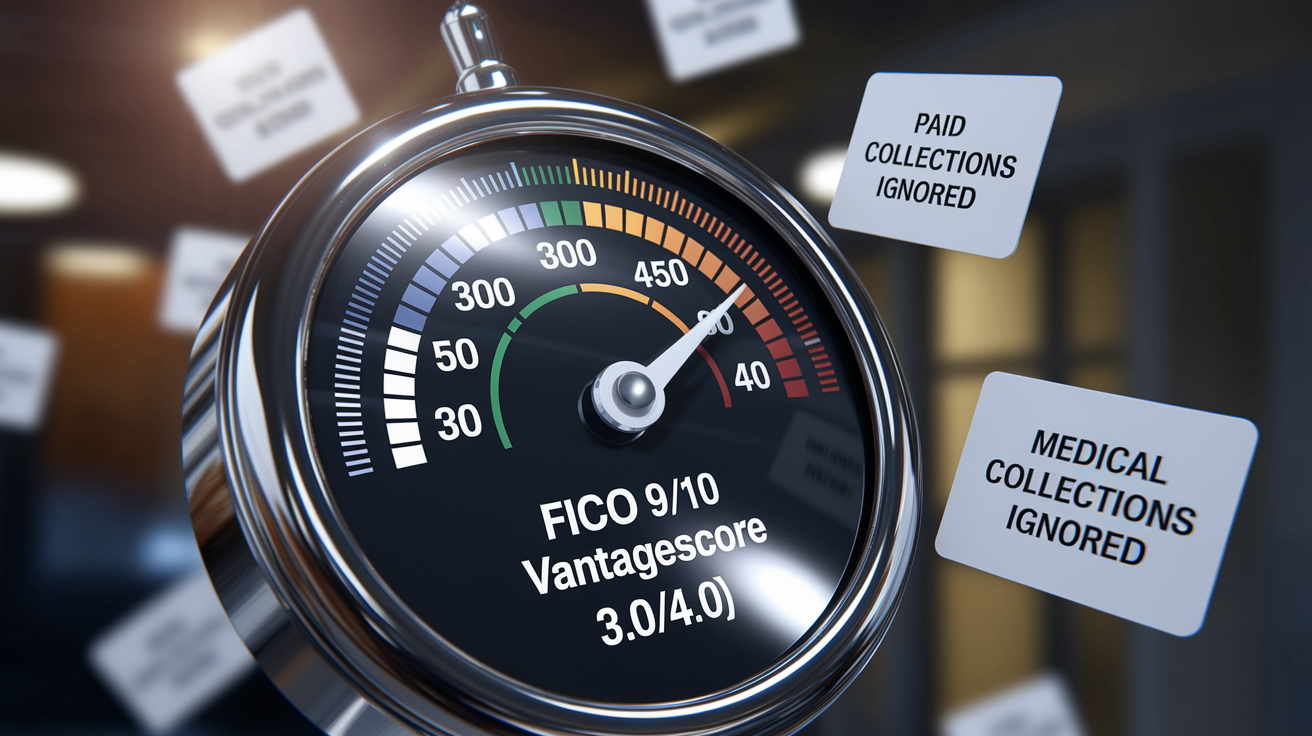
Payment history is the biggest piece of your FICO score, about 35 percent of the whole thing. Collections are one of the worst marks in that category. When an account goes to collections, usually after 90 to 180 days of missed payments, the original late payments and the new collection tradeline both show up on your credit report. The collection tells lenders you didn’t repay a debt even after repeated attempts to collect, which is why the score drop can blow past 100 points. That penalty sticks for up to seven years from the date of your first missed payment. Not from the date the account went to collections or the date you paid it. The seven year clock starts ticking the moment you first fell behind, so a collection that pops up today might be four years old and have only three years left on your report.
The score impact of paying a collection depends entirely on which FICO or VantageScore model a lender uses. FICO 8 came out in 2009 and it’s still the most common model for credit card approvals and many personal loans. It treats all collection accounts over $100 the same whether you pay them or not. Under FICO 8, paying a $2,000 collection down to zero might feel like progress, but your score won’t budge because the account still exists. FICO 9 and FICO 10 ignore paid collections entirely and reduce the penalty for unpaid medical collections. VantageScore 3.0 and 4.0 go even further. They ignore all paid collections and all medical collections, paid or unpaid. If your mortgage lender pulls VantageScore 4.0 and you’ve paid every collection on your file, those accounts contribute zero negative weight to your score.
| Model | Paid Collection Impact | Medical Collection Treatment |
|---|---|---|
| FICO 8 | Counts paid and unpaid collections equally if over $100 | Counts all medical collections over $100 |
| FICO 9 / FICO 10 / 10T | Ignores paid collections; penalizes unpaid collections | Reduced penalty for medical collections; ignores paid medical collections |
| VantageScore 3.0 / 4.0 | Ignores all paid collections | Ignores all medical collections, paid or unpaid |
Verifying, Disputing, and Validating Collections Before Paying

Before you send any payment to a collector, verify that the debt is legitimate, accurate, and legally yours. Debt collectors have to send you a written validation notice within five days of first contact, listing the amount owed, the name of the original creditor, and your right to dispute the debt within 30 days. If you dispute in writing within that 30 day window, the collector has to stop collection activity until they provide verification. Skip this step and you might pay a debt that’s already past the statute of limitations, confirm an account that wasn’t yours, or restart the clock on legal action in some states. Validation protects your rights and makes sure what’s on your credit report matches reality.
Once you have validation, or if the collector fails to provide it, pull your credit reports from all three major bureaus and compare the details. Look for accounts that don’t belong to you, duplicate collections, incorrect balances, or collections that should have aged off after seven years. Inaccurate information gets disputed directly with each bureau that’s reporting it, not just with the collector. Medical collections under $500 and medical collections less than one year old aren’t allowed on credit reports under current bureau policies. If you see them, dispute immediately and reference the reporting restriction. Paid medical collections of any amount must also be removed. Bureaus have to investigate disputes within 30 to 45 days and either correct the information or confirm it’s accurate.
Here’s how to verify and dispute collections effectively:
Pull your credit reports from all three bureaus. Use the free annual report portal or a credit monitoring service to get current copies. Review every collection account for accuracy in amount, dates, and creditor name.
Request written debt validation from the collector within 30 days of first contact. Send your request by certified mail with return receipt. Ask for proof of the debt, the original creditor’s name, and documentation that the collector has legal standing to collect.
Submit disputes with supporting documentation to each bureau reporting the error. File online or by certified mail. Include account numbers, explanations, and copies (never originals) of any proof like payment records, identity theft reports, or validation failures.
Monitor investigation deadlines and follow up if needed. Bureaus must complete investigations within 30 to 45 days. If they don’t respond or you disagree with the outcome, escalate by adding a consumer statement or filing a complaint with the Consumer Financial Protection Bureau.
Confirm removals across all three reports. An account deleted by one bureau may still appear on the others. Check each report after the investigation closes and dispute again if the item reappears or remains on any bureau.
Negotiating Collections: Settlement, Pay for Delete, and Written Agreements

Once you’ve validated a collection and confirmed it’s accurate, you’ve got leverage to negotiate how the account gets reported after you pay. Collectors want to close accounts and recover money, which means they’re often willing to accept less than the full balance or agree to remove the tradeline entirely in exchange for payment. Pay for delete is the term for an arrangement where the collector agrees in writing to delete the account from your credit report once you’ve paid in full or settled. It’s legal, but collectors aren’t required to offer it, and success rates vary by agency and account age. Some collectors have internal policies against pay for delete, while others will agree if you ask directly and frame it as a condition of payment. Never assume a verbal promise will be honored. Get every term in writing before you send a check or authorize a payment.
If pay for delete isn’t an option, your next best outcome is a settlement for less than the full balance with an agreement to report the account as “paid in full” rather than “settled for less than owed.” A “paid in full” notation looks better to human underwriters, even though both show the account was in collections. When negotiating, start by asking what the collector will accept as a lump sum payoff, then counter with a lower amount if your budget is tight. Collectors often have authority to settle for 40 to 60 percent of the balance, especially on older debts. Document every conversation. Note the date, time, representative’s name, and what was agreed. Follow up in writing to confirm terms before making any payment, and specify that your payment depends on the written agreement. Once you pay, keep proof of payment and monitor your credit reports to confirm the account updates as agreed within one to two billing cycles.
Key Terms to Insist on in Collection Agreements
When you negotiate a settlement or pay for delete, the exact language in your written agreement determines what appears on your credit report. “Delete upon payment” or “remove tradeline after payment clears” means the account will disappear entirely from your report, which is your best outcome under any scoring model. “Paid in full” means the balance goes to zero and the status updates to paid, which helps under FICO 9/10 and VantageScore 3.0/4.0 but may not change your FICO 8 score. “Settled for less than the full balance” or “settled” signals that you paid less than owed, which still closes the account but can raise questions with manual underwriters. Never accept vague promises like “we’ll update your account” or “we’ll report it accurately.” Those phrases don’t commit the collector to any specific action. Insist on written confirmation that includes your name, the account number, the exact amount you’ll pay, the deadline for payment, and the precise reporting outcome you’ve agreed on. If the collector won’t put it in writing, don’t pay yet.
Payment Strategy: Which Collections to Pay First and Why

Not all collections have the same impact on your credit score or your financial risk, so choosing which accounts to pay first can save you money and speed up your recovery. Medical collections should be at the top of your list for two reasons. Paid medical collections are removed from credit reports entirely under current bureau rules, and medical collections under $500 aren’t reported at all. If you’ve got a $300 medical collection from an urgent care visit or a $450 lab bill in collections, paying those accounts triggers immediate removal from all three bureaus, which can raise your score under every scoring model. Even if the medical debt is over $500, paying it removes the tradeline completely, so you get full credit for the payment with no lingering negative mark.
After medical collections, focus on accounts that carry the highest legal or financial risk. Collections from creditors known to file lawsuits frequently (large credit card issuers, auto lenders, and some collection agencies) should be prioritized, especially if the debt is recent and the balance is over $1,000. A lawsuit can lead to a judgment, wage garnishment, or bank levy, all of which create new financial emergencies and additional credit damage. If you’re planning to apply for a mortgage in the next 12 to 24 months, pay any collections that will be reviewed manually by an underwriter, regardless of scoring model. Mortgage lenders often require explanations or payoffs for recent collections, and paying them early removes that obstacle. Smaller, older collections that are close to the seven year mark can often wait. They’ll age off naturally, and paying them under FICO 8 won’t change your score anyway.
Under newer scoring models like FICO 9, FICO 10, VantageScore 3.0, and VantageScore 4.0, every paid collection you eliminate raises your score because those models ignore paid accounts. If you know a lender uses one of those models, paying collections becomes a direct path to approval. Many mortgage lenders are transitioning to FICO 10T and VantageScore 4.0 by the end of 2025 under new federal guidelines, so paying collections now sets you up for better rates when that shift completes. If your goal is a credit card or auto loan and you’re not sure which model the lender uses, assume FICO 8 is in play and prioritize collections that also reduce your legal risk or eliminate high balances, so you get value from the payment even if your score doesn’t jump immediately.
Rebuilding Credit After Collections: Adding Positive Data Rapidly

Paying or disputing collections removes negative weight, but raising your FICO score after collections requires adding fresh, positive payment history to your credit file. Payment history makes up 35 to 40 percent of most scoring models, so every on time payment you add dilutes the impact of past collections and shows you’re managing credit responsibly now. The fastest way to start is with a secured credit card, which requires a cash deposit that becomes your credit limit. Use the card for a small recurring bill (streaming service, phone plan, gas) and pay the balance in full every month. Secured cards report to all three bureaus just like unsecured cards, so each on time payment builds positive history. After six to twelve months of clean payment behavior, many issuers will graduate you to an unsecured card and refund your deposit.
Credit builder loans work differently but deliver similar results. You borrow a small amount (often $300 to $1,000) and the lender holds the funds in a locked savings account while you make monthly payments. Each payment is reported to the bureaus, and once the loan is paid off, you receive the funds. The loan adds a new installment tradeline to your mix of credit, and the combination of on time payments and a small savings cushion can raise your score by 30 to 60 points over the life of the loan. If you can’t qualify for a secured card or credit builder loan on your own, ask a trusted family member or friend with strong credit to add you as an authorized user on one of their credit cards. You inherit the account’s payment history and utilization, which can provide an immediate score boost. The risk is that if the primary cardholder misses a payment or runs up the balance, your score will drop too, so only use this strategy with someone whose habits you trust completely.
Reporting rent and utility payments to the credit bureaus is another fast way to add positive data without taking on new debt. Rent reporting services and tools that add utility, phone, and streaming payments to your credit file can add 12 to 24 months of on time payment history in a matter of weeks, which helps offset the damage from collections. These accounts typically appear as tradelines on Experian and sometimes on Equifax or TransUnion, depending on the service. While not all scoring models weigh these payments as heavily as traditional credit accounts, they still contribute to your payment history and can help you cross approval thresholds for cards and loans.
Here’s how to layer positive tradelines quickly and safely:
Open a secured credit card with a $200 to $500 deposit and use it for one recurring bill each month. Pay the statement balance in full to avoid interest. After six months of on time payments, request an upgrade to unsecured or apply for a second card.
Take out a credit builder loan from a credit union or online lender. Choose a term of 12 to 24 months and set up automatic payments so you never miss a due date.
Become an authorized user on a family member’s or partner’s oldest, lowest utilization card. Confirm the issuer reports authorized users to all three bureaus before asking to be added.
Sign up for a rent reporting service that adds your current and past rent payments to your Experian file. Look for services that also report utilities, phone, and streaming subscriptions for maximum impact.
Keep utilization below 10 percent on all revolving accounts. Low utilization signals you’re not relying heavily on credit, which speeds up score recovery and improves approval odds.
Managing Credit Utilization, New Credit, and Hard Inquiries During Recovery
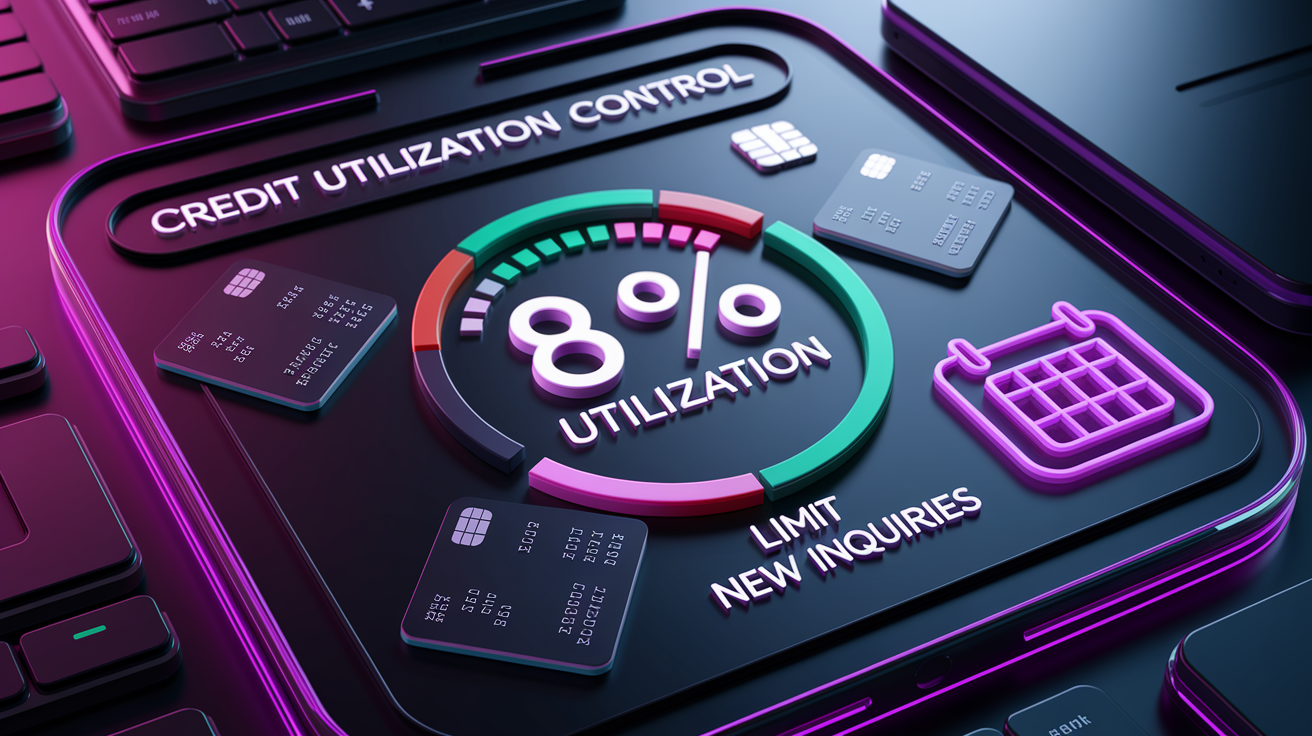
Credit utilization (the percentage of your available credit you’re using at any given time) is the second largest factor in your FICO score after payment history, making up roughly 30 percent of the calculation. High utilization signals financial stress, so even if you’re making on time payments, carrying balances above 30 percent of your limits can stall your score recovery. Keep utilization below 10 percent on each card and across all cards combined. If you have a $500 secured card, that means keeping your reported balance under $50. Utilization gets calculated from the balance that appears on your statement, so paying down your balance before the statement closes can lower your reported utilization even if you use the card heavily throughout the month.
Hard inquiries from new credit applications can also slow your recovery. Each inquiry can drop your score by 3 to 5 points, and multiple inquiries in a short period can signal desperation to lenders. During the first six to twelve months after addressing collections, limit applications to one or two strategic accounts (your secured card and maybe a credit builder loan) and avoid applying for retail cards, auto loans, or other credit until your score stabilizes. Once you’ve added six months of positive payment history and your collections are paid or aging off, inquiries will hurt less and you’ll have more approval options.
Here’s how to keep utilization and inquiries in check while rebuilding:
Pay down credit card balances to below 10 percent of each limit before your statement closes each month. If you can’t pay the full balance, pay enough to keep utilization in single digits.
Request credit limit increases on existing cards after six months of on time payments. A higher limit with the same balance lowers your utilization ratio automatically.
Don’t apply for new credit unless it directly supports your rebuild plan. One secured card and one credit builder loan are enough for the first year. Additional inquiries create more risk than reward.
Monitoring Progress and Confirming Accurate Reporting After Collection Updates
Creditors and collection agencies typically report account updates to the credit bureaus once per month, which means changes from paid collections, deletions, or dispute resolutions can take 30 to 60 days to appear on all three reports. Monitoring your credit regularly lets you confirm that payments, settlements, and negotiated deletions are reflected accurately and that no new errors have appeared. You’re entitled to one free credit report from each bureau every year through the official annual report portal, but during active credit repair, monthly monitoring gives you faster visibility into changes and lets you catch problems before they cost you an approval.
Credit monitoring tools that pull your reports weekly or daily can alert you to new collections, late payments, or inquiries, and many provide access to at least one of your FICO scores. Some tools offer score simulators that estimate how actions like paying a collection or opening a new card might affect your score, but these are projections, not guarantees. Your actual score change depends on your full credit profile and the scoring model in use. If you’ve negotiated pay for delete or disputed an account, check all three bureau reports 45 to 60 days after resolution to verify the account is gone or updated correctly. If a bureau still shows an account you’ve successfully disputed, file a second dispute referencing the original investigation and include proof of the deletion from the other bureaus.
What to Check After a Collection Is Paid or Removed
After you pay a collection or win a dispute, pull updated reports from Equifax, Experian, and TransUnion and verify four key data points on each. The account status should read “paid” or be absent entirely. The balance should show $0 if paid, or be removed if deleted. The date last updated should reflect the current month or the month you made payment. All three reports should match. If one bureau shows the account as paid and another still lists it as unpaid, dispute the outdated entry with the lagging bureau and include proof from the bureau that updated correctly. Small discrepancies (a balance off by a few dollars or a status update delayed by one billing cycle) usually resolve on their own, but large errors like an account reappearing after deletion or a paid account still showing a balance require immediate follow up. Keep copies of settlement letters, payment confirmations, and dispute responses so you have documentation if you need to escalate with the bureaus or file a complaint with the Consumer Financial Protection Bureau.
Final Words
Start now: validate any collection, dispute inaccuracies within 30–45 days, negotiate pay‑for‑delete when you can, and prioritize paying or settling accounts that will move the needle most. Add positive tradelines and keep utilization low.
Remember score models differ: FICO 8 may treat paid collections the same, while newer models and VantageScore often ignore paid collections. Expect changes to show over months, and check all three reports.
Use this checklist—validate, dispute, negotiate, pay smart, rebuild—and you’ll be following the best ways to raise FICO score after collections. Small, steady moves add up; you’ll see progress.
FAQ
Q: How to raise credit score after paying collections?
A: To raise your credit score after paying collections, verify deletion or updated status, dispute any errors, negotiate pay‑for‑delete when possible, lower utilization, and add positive tradelines like secured cards or credit‑builder loans.
Q: What is the 7 7 7 rule for collections?
A: The 7 7 7 rule for collections is not a legal standard; it’s an informal industry timing guideline some collectors mention. Rely instead on debt validation timelines (5 days after contact) and bureau disputes (30–45 days).
Q: What is the 609 loophole?
A: The 609 loophole is a myth; section 609 lets consumers request disclosures from credit bureaus but doesn’t force removals. Only inaccurate or unverifiable items can be removed through disputes and debt validation.
Q: Will paying off collections improve FICO score?
A: Paying off collections will sometimes improve your FICO score, but it depends on the model — FICO 9/10 and VantageScore ignore paid collections, while FICO 8 may still treat them the same, so results vary.