


Paying off your smallest credit card first—rather than the highest-interest one—sounds backwards, but it often gets you to zero faster.
The snowball method does exactly that: you attack the smallest balance while making minimums on the rest, then roll each freed-up payment into the next card.
This post shows the step-by-step setup, real-number examples, the trade-offs with the interest-focused “avalanche” approach, and simple ways to speed the plan so you finish sooner.
If you’ve stalled on debt before, the snowball’s early wins are what keep most people going.
How the Snowball Method Works for Credit Card Debt

The debt snowball method pays off credit card balances by going after your smallest balance first while making minimum payments on everything else. When one card hits zero, you roll that entire payment (minimum plus extra) into the next smallest balance. It builds on itself as you go.
This works especially well for credit cards because early wins keep you in the fight. Closing out a $300 balance feels real. It clears mental space, frees up a monthly slot, and proves the plan actually works. That psychological boost is what keeps most people going until the last card’s done. The snowball isn’t the cheapest route by total interest, but it’s effective because it helps you stick with repayment long enough to finish.
Here’s how to run a credit card snowball:
- List every credit card balance from smallest to largest. Ignore interest rates and credit limits.
- Set up automatic minimum payments on all cards to avoid late fees and score damage.
- Calculate your monthly extra payment. Whatever fixed amount you can consistently add beyond minimums, even if it’s $50.
- Apply that extra amount to the card with the smallest balance until it’s paid off.
- Add the full payment you were making on that card to the minimum of the next smallest balance.
- Repeat until all cards are at zero, and don’t put new charges on paid-off cards.
In one documented example, a household using the snowball paid off debts more than five years sooner than they would have by making minimum payments only. They saved more than $4,300 in interest, even though they weren’t always optimizing for the lowest APR first.
Step-by-Step Credit Card Snowball Setup and Payment Strategy

Setting up your snowball correctly from day one helps you avoid missteps, track progress, and stay consistent. Start by pulling your most recent statements for every credit card. Write down each balance, the card’s APR, and the current minimum payment. Order them by balance size, not by APR, credit limit, or which card you opened first. Leave your mortgage off the list. The snowball focuses on unsecured revolving debt.
Next, decide on your extra monthly payment amount. This is the fixed cash you’ll add to the smallest balance every month. Look at your budget: subscriptions you can pause, dining out nights you can skip, unnecessary memberships, or irregular purchases you can delay. If you can scrape together $75, that’s your number. If you can hit $200, even better. The key is consistency. Pick an amount you can sustain for months, not a heroic one-time push.
Building Your Snowball Plan
Your snowball plan lives in a simple spreadsheet or notepad. For each card, record the creditor name, current balance, APR, minimum payment, and payoff order. Number them 1, 2, 3 by balance size. Card #1 gets your full extra payment plus its minimum until it’s cleared. Card #2 waits its turn. This ordering may feel backward if your highest-rate card has the biggest balance, but the snowball relies on quick wins to build confidence.
Automate every minimum payment through your bank or card issuer. This protects your credit score and removes the risk of a forgotten due date derailing your plan. Once automation is live, your only manual job each month is to send the extra payment to the target card.
Budget tweaks that free up extra snowball money include cutting one streaming service ($15), skipping two takeout meals per week ($60), dropping premium memberships you rarely use ($20), or selling unused items for a one-time $200 boost you can fold into Month 1.
Real Credit Card Snowball Example Using Multiple Cards
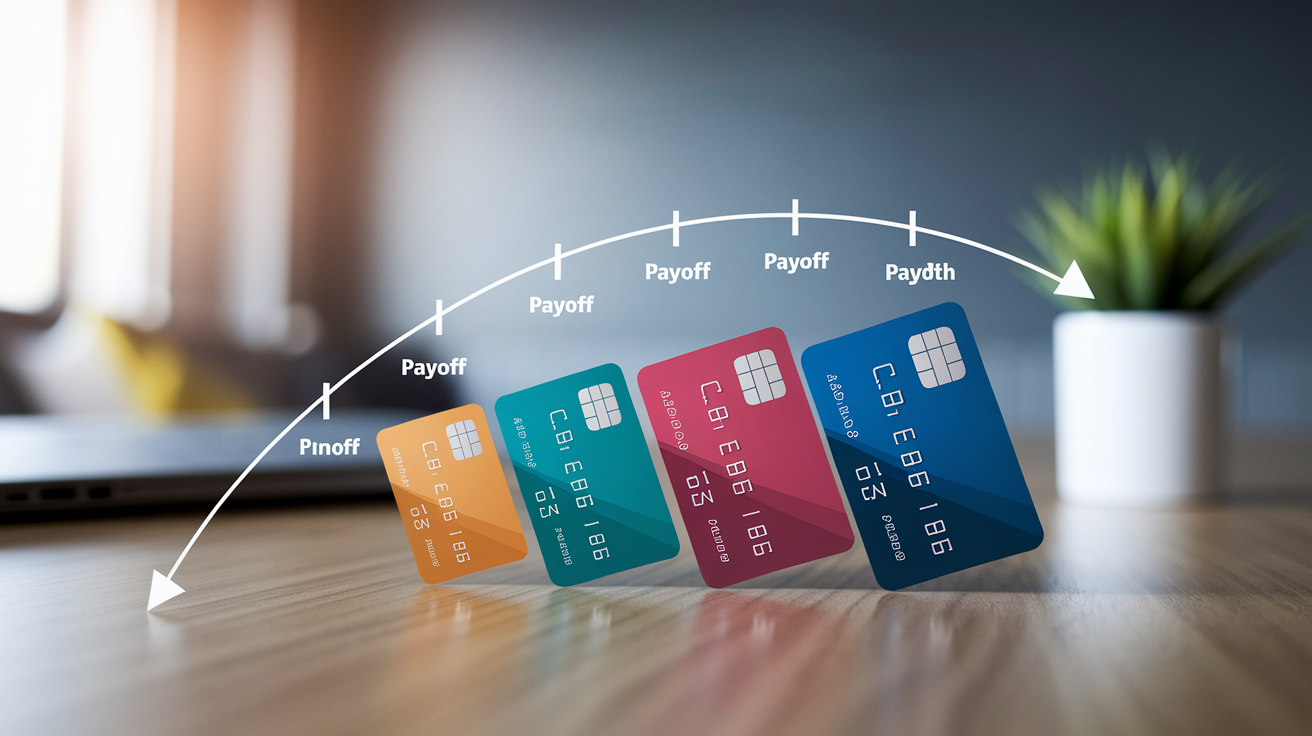
Here’s how the snowball plays out with four real credit card balances, ordered smallest to largest, and an extra $150 added every month.
| Debt | Balance | APR | Minimum Payment | Payoff Order | Months to Payoff (Snowball + $150) |
|---|---|---|---|---|---|
| Store card | $480 | 26.9% | $25 | 1 | 3 |
| Medical credit line | $1,200 | 0% (promo) | $50 | 2 | 7 (cumulative) |
| Cash-back rewards card | $3,000 | 18.9% | $90 | 3 | 16 (cumulative) |
| Travel rewards card | $5,200 | 22.9% | $130 | 4 | 29 (cumulative) |
In Month 1, you pay $25 + $150 = $175 toward the $480 store card and minimums on the rest. The store card is cleared in three months. Starting Month 4, you roll that $175 into the medical line’s $50 minimum for a total of $225 per month. The medical line is paid by Month 7.
Then you add $225 to the $90 cash-back minimum for $315 monthly, clearing that card by Month 16. Finally, you combine $315 with the $130 travel-card minimum for $445 per month, finishing all four cards by Month 29. Under two and a half years.
Compare that to a minimum-payment-only scenario, where the same four balances might take seven years or longer to clear and cost thousands more in interest. The snowball shortens the timeline by more than five years in many real-world examples and saves $4,300+ in interest, even when you’re not targeting the highest APR first. The math isn’t perfect, but the behavior is sustainable.
Early payoffs also free up mental energy. Closing the first card in three months proves the system works. That win builds confidence to tackle the next balance, and momentum compounds as payments roll forward.
Comparing the Snowball Method to the Debt Avalanche Approach

The debt avalanche method orders repayment by APR, targeting the highest interest rate balance first. It minimizes total interest paid over the life of your debt, often saving hundreds or thousands compared to the snowball. If you owe $5,000 at 24.9% APR and $1,000 at 14.9%, the avalanche sends all extra cash to the 24.9% card, even though it’s the larger balance.
The snowball does the opposite. It pays the $1,000 card first, generating a quick win and rolling that payment into the bigger card. You’ll likely pay more interest with the snowball, especially if your highest-rate card also carries your largest balance. But the snowball’s advantage is behavioral. Early account closures keep you motivated, reduce decision fatigue, and lower the risk you’ll quit halfway through.
If you’re confident in your discipline and want to save the most money, the avalanche is mathematically superior. If you’ve tried paying down debt before and stalled out, or if seeing progress fast matters more than squeezing every dollar of savings, the snowball often works better. Some people use a hybrid strategy. Knock out one or two small balances with the snowball for early momentum, then switch to avalanche ordering for the remaining high-APR cards.
Key differences:
Ordering rule: Snowball uses balance size; avalanche uses APR.
Interest cost: Avalanche minimizes total interest; snowball may cost more but keeps you engaged.
Psychological impact: Snowball delivers faster wins; avalanche requires patience if the highest-rate debt is also the largest.
Best fit: Use snowball when motivation and consistency are your main risks. Use avalanche when minimizing cost is the top priority and you can stay disciplined without quick wins.
Pros and Cons of the Credit Card Debt Snowball Strategy

The snowball has clear strengths and real trade-offs. Understanding both helps you decide if it’s the right fit for your situation and credit card balances.
Pros:
Early wins create momentum. Paying off a small card in a few months proves the plan works and builds confidence to keep going.
Simple to understand and track. You don’t need to calculate interest differentials or run complex scenarios. Just order by balance and attack the smallest.
Can still save hundreds to thousands in interest. Even without extra payments, reordering payoff priority and rolling freed-up cash forward reduces total interest versus making minimums forever.
Higher success rate for people who need motivation. Behavioral consistency matters more than perfect math if it’s the difference between finishing and quitting.
Cons:
May cost more in total interest than the avalanche. Leaving high-APR balances for later increases the interest you’ll pay over time.
Slower payoff of large, high-rate cards. If your biggest card also has the highest APR, you’ll carry that expensive balance longer.
Requires strict discipline to avoid new debt. Paying off a card and then immediately charging new purchases undoes your progress.
Not ideal if interest minimization is your only goal. The avalanche method is the better mathematical choice if saving every possible dollar on interest is what matters most.
Ways to Accelerate Credit Card Snowball Progress
Speeding up your snowball means either increasing the extra payment you send each month or cutting expenses to free up more cash. The faster you knock out each balance, the sooner you roll bigger payments into the next card and the less interest you pay overall.
One tactic is debt snowflaking. Small, irregular amounts you scrape together weekly or even daily and immediately apply to your target card. Skip one coffee shop visit and send the $6 to your smallest card. Sell an old phone and add the $120 to next month’s payment. Cancel a subscription mid-month and redirect the refund. These micro-payments don’t replace your fixed monthly extra, but they shorten payoff timelines by weeks or months when you add them up.
Ways to generate extra snowball money:
Start a side hustle or pick up freelance work. Even $300 extra per month can cut years off your timeline.
Negotiate lower recurring bills. Call your internet or cell provider and ask for a discount or a cheaper plan. $40 saved per month is $480 more toward debt in a year.
Cut discretionary spending temporarily. Pause dining out, delay non-essential purchases, or skip entertainment subscriptions for six months.
Use windfalls strategically. Tax refunds, bonuses, or gifts can make a big dent when applied directly to the smallest balance.
Automate raises or income bumps. If you get a raise, immediately route the increase to your snowball payment before lifestyle inflation sets in.
Use a debt snowball calculator to model how different extra-payment amounts change your payoff date and total interest. Seeing that an extra $100 per month shaves 18 months off your timeline can motivate you to find that cash in your budget.
Improving Credit While Using the Snowball Method

Paying down credit card balances with the snowball improves your credit score in measurable ways. As each balance drops, your credit utilization ratio (the percentage of available credit you’re using) falls. Utilization under 30 percent is good; under 10 percent is excellent. Lower utilization signals to credit bureaus that you’re managing credit responsibly, and your score typically rises as a result.
Automating minimum payments protects your payment history, which is the largest factor in your credit score. A single missed payment can drop your score by 50+ points and stay on your report for seven years. By setting up auto-pay, you remove the risk of a forgotten due date derailing both your credit and your snowball plan.
As you pay off each card, avoid the temptation to close the account immediately. Keeping it open preserves your total available credit and helps utilization. If the card has an annual fee and you’re not using it, close it only after you’ve paid off all other balances.
Credit protection habits during the snowball:
Check your credit report every few months to verify balances are updating correctly and catch errors or fraud early.
Keep paid-off cards open and unused (unless they carry fees) to maintain your credit history length and total credit limit.
Avoid new credit applications while paying down debt. Each hard inquiry can temporarily lower your score.
Monitor your score through free tools to see progress as balances drop and utilization improves.
If you’re working with a credit counseling service or debt management plan, know that some programs require you to close credit card accounts as part of enrollment. That can temporarily hurt your score, but it may be worth the trade-off if the plan negotiates lower interest rates or monthly payments you can actually afford.
When to Consider Alternatives to the Snowball Method

The snowball works well for people who need quick wins and behavioral momentum, but it’s not the best fit for every situation. If minimizing total interest cost is your top priority and you’re confident you won’t lose motivation, the debt avalanche will save you more money by targeting the highest APR first.
Debt consolidation can be a better move if you qualify for a personal loan with a lower APR than your credit cards. For example, consolidating $10,000 in credit card debt at 22% APR into a three-year personal loan at 12% APR saves thousands in interest and simplifies repayment to one fixed monthly payment. Consolidation works best if you have good or excellent credit to secure a competitive rate and the discipline not to run up new balances on the cards you just paid off.
Balance transfer credit cards with 0% introductory APR can also beat the snowball if you can pay the transferred balance within the promotional period, usually 12 to 21 months. You’ll pay a transfer fee (typically 3% to 5% of the balance), but you avoid interest entirely if you clear the debt before the promo ends. This option requires strong credit to qualify and strict budgeting to hit the payoff deadline.
When to consider specific alternatives:
Debt avalanche: You’re disciplined, motivated by math over quick wins, and want to minimize total interest paid.
Debt consolidation loan: You have good credit, qualify for a lower fixed rate, and want one predictable monthly payment.
Balance transfer card: You can pay the balance within the 0% intro period and have the credit score to qualify for a low or no transfer fee.
Credit counseling or debt management plan: You’re behind on payments, need negotiated lower rates or monthly amounts, and are willing to accept fees and potential account closures.
Hybrid snowball-avalanche: You want early motivation from one or two quick wins, then switch to highest-APR ordering for remaining balances.
Each alternative has risks. Consolidation loans and balance transfers only help if you avoid new debt on the cards you just cleared. Credit counseling plans can lower your score temporarily and may charge setup or monthly fees. Weigh the trade-offs against your income stability, credit profile, and ability to stick with a repayment strategy for 12 to 36 months.
Final Words
Start by listing your credit cards smallest to largest, automate minimum payments, and funnel any extra cash to the smallest balance. That simple action creates quick wins and a repeatable payoff rhythm.
This guide covered a step-by-step setup, a real multi-card example (showing >5-year timeline cuts and $4,300+ interest savings), the snowball vs. avalanche tradeoffs, acceleration tactics, and credit-protection habits.
Try the credit card debt snowball method with one fixed extra payment this month. Small wins add up. You’ll build momentum and confidence fast.
FAQ
Q: Does the snowball method work for credit card debt?
A: The snowball method works for credit card debt by paying minimums on all cards while attacking the smallest balance first; it creates quick wins and momentum but can cost more interest than an APR-first approach.
Q: How to get rid of $30,000 credit card debt?
A: To get rid of $30,000 credit card debt, choose a plan (snowball or avalanche), automate minimums, free up cash (cut expenses, side gig, negotiate bills), consider balance-transfer or consolidation, and track progress.
Q: Is $20,000 in credit card debt a lot?
A: A $20,000 credit card balance is significant for many people; its impact depends on income and limits—at 20% APR it produces roughly $333 in interest monthly if you only pay interest and raises utilization risk.
Q: What is the 7 year rule for credit card debt?
A: The 7 year rule for credit card debt means most negative credit items, like late payments or charge-offs, drop from your credit report seven years after the first missed payment; the debt and collection rights may still remain.