


Is paying your smallest debts first smart budgeting or a costly mistake?
The debt snowball ranks balances smallest to largest and sends every extra dollar to the tiniest account while you pay minimums on the rest.
That creates fast wins that build momentum, but it can cost you more in interest if high-rate debts sit untouched.
This intro will show when the snowball helps you stick to a plan and when the avalanche (highest-rate-first) likely saves money, so you can choose the better path.
Immediate Breakdown of Debt Snowball Advantages and Disadvantages

The debt snowball method ranks your debts smallest to largest by balance. Interest rates don’t matter in the ranking. You pay minimums on everything, then throw every extra dollar at the smallest balance until it’s gone. Once that debt disappears, you roll the full payment (minimum plus extra) into the next smallest balance. The process repeats, building a “snowball” of bigger payments as you move up the list.
The big advantage is momentum. Killing off a small debt fast gives you a win, and that win makes it easier to stick with the plan. Early victories matter when you’re staring at a pile of balances and trying to build a habit that lasts. The snowball is simple to execute. No interest rate math, no complex ranking. That simplicity cuts down on decision fatigue. For people who need regular progress signals to stay motivated, this method delivers.
The disadvantage is cost. Because the snowball ignores interest rates, you might carry high-APR debts longer than you should, which means more total interest paid. Targeting high-interest balances first (the debt avalanche) saves more money and usually shortens the overall payoff period. The snowball also tends to stretch your time in debt, especially if your smallest balances carry low rates and your largest ones carry high rates. In 2020, the average American with debt was paying 33 percent of monthly income to debt. Choosing a method that drags out repayment can put serious pressure on cash flow.
Quick snapshot of debt snowball traits:
- Fast wins that fuel motivation
- Strong reinforcement through early account closures
- Simple to rank and execute
- Higher total interest vs. avalanche
- Less optimal on cost
- Can extend overall payoff period
How the Debt Snowball Strategy Works Step-by-Step
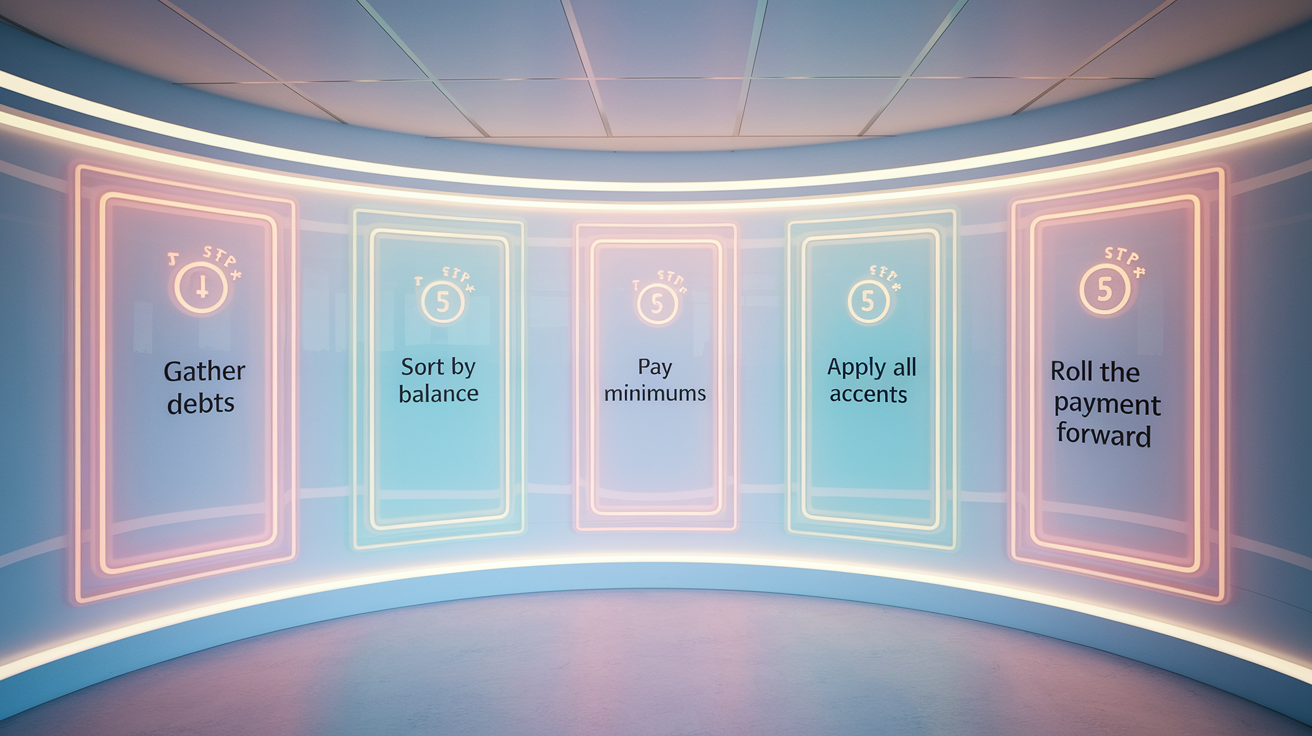
Start by gathering every debt you owe. Credit cards, car loans, personal loans, student loans, medical bills. Write down the current balance and the interest rate for each. Then rank the debts by balance, smallest to largest. Ignore the interest rates completely. This balance-only ranking is what sets the snowball apart and drives the psychological benefit. Focusing on the smallest number first creates targets you can actually hit in the short term, which keeps you engaged.
Next, figure out your extra payment capacity. Subtract fixed monthly expenses and all minimum debt payments from your take-home income. What’s left is your extra payment power. In one example, a borrower found $300 per month after covering necessities and minimums. That $300 becomes your weapon against the smallest debt.
Five steps to run the debt snowball:
- List every debt with current balance and APR for each account.
- Sort by smallest balance to largest (ignore interest rates here).
- Pay the minimum on every debt to protect your credit and avoid fees or penalties.
- Apply all extra funds to the smallest balance. If you’ve got $300 extra and the car loan minimum is $132, you’d pay $432 total on that account each month.
- Roll the payment forward once the smallest debt is paid off. Take the full amount you were paying on that account and add it to the minimum on your next smallest debt. That’s the snowball effect.
Behavioral Science Behind the Debt Snowball’s Effectiveness

Early wins create a motivation cycle that behavioral economists call positive reinforcement. When you wipe out a full account within a few months, your brain registers real progress. That feeling strengthens the habit of making extra payments, which increases the odds you’ll stick with the plan long term. Habit formation depends on feedback loops, and the debt snowball delivers feedback faster than methods that go after larger, high-interest balances first. Closing an account feels like crossing a finish line. That emotional reward makes the next payment easier to commit to.
Simplicity helps too. The snowball uses one ranking criterion: balance. You never have to recalculate priorities or second-guess your target. This cuts down on cognitive load and decision fatigue, which is especially valuable when you’re already stressed about money. The clearer the system, the less willpower required to follow it. The snowball’s clarity is one of its strongest behavioral features.
Momentum compounds as balances disappear. Each closed account frees up mental energy and reduces the number of bills you’re tracking. As your payment power grows (because you’re rolling previous payments forward), you start seeing larger debts fall faster. This acceleration can reduce the financial anxiety that makes debt feel crushing. In survey data, 59 percent of adults reported anxiety about personal finances. Structured progress can lower that stress by giving you visible control over the outcome.
Key behavioral mechanisms:
- Early account closures serve as immediate reinforcement
- Reduced overwhelm through simplified balance-only ranking
- Momentum builds as each debt is eliminated
- Motivation loops sustain effort by delivering frequent wins
Cost and Efficiency Limitations of the Debt Snowball Method
The snowball’s psychological strength comes with a math problem. By ignoring interest rates, you might leave high-APR debts untouched longer, and compound interest on those balances keeps piling up. Say your smallest balance is a $1,200 medical bill at 0 percent interest and your largest is a $4,000 credit card at 24.99 percent APR. The snowball sends extra payments to the medical bill first. That means the 24.99 percent card keeps charging interest on $4,000 while you work through smaller, cheaper debts. Over time, this sequence increases total dollars paid.
The debt avalanche (which targets the highest interest rate first) typically saves more money and shortens the overall payoff timeline. Paying down high-APR debt as fast as possible minimizes the interest that accrues each month, which frees up dollars to apply to other balances sooner. The avalanche is the more efficient path if cost and speed are your main goals.
| Factor | Snowball | Avalanche |
|---|---|---|
| Interest Cost | Higher total interest paid | Lower total interest paid |
| Payoff Speed | May extend overall timeline | Typically faster overall |
| Motivation | Frequent wins, strong reinforcement | Slower initial wins, requires discipline |
| Complexity | Simple (balance ranking only) | Slightly more complex (APR ranking) |
| Best User Fit | Needs behavioral momentum | Prioritizes cost efficiency |
Decision Framework: Choosing Between Snowball and Avalanche

If you need regular, visible progress to stay committed, the snowball is probably the right fit. The method works best when motivation is fragile or when past attempts to pay down debt failed because the plan felt too slow or too abstract. Some people function better with short-term targets and emotional wins than with spreadsheets showing long-term savings. That’s not a weakness. It’s a psychological reality, and the snowball is built for it.
If cutting total interest paid and shortening your time in debt are your top priorities, and you can maintain discipline without frequent reinforcement, the avalanche is the better choice. The avalanche delivers the most cost-efficient outcome in almost every scenario, especially when high-APR credit card debt is involved. The tradeoff is patience. Progress on individual accounts can feel slow if the highest-interest debt also has a large balance, and that can test your commitment early in the process.
When Snowball is Better
Choose the snowball if you’re overwhelmed by the number of accounts you’re juggling, if you’ve struggled to stick to repayment plans in the past, or if you need the confidence boost of early wins to prove to yourself that progress is possible. The method is also a strong fit if your debt mix includes several small balances with similar interest rates. Eliminating those quickly creates momentum without giving up much in cost efficiency. People with variable income or unpredictable cash flow may also prefer the snowball’s simplicity and the clear sense of forward motion it provides.
Comparison of core decision factors:
- Motivation vs cost: Snowball prioritizes motivation, avalanche prioritizes cutting interest.
- Progress speed: Snowball delivers faster visible wins on individual accounts, avalanche delivers faster total payoff and lower cost.
- Interest savings: Avalanche nearly always saves more in total interest paid.
- Staying power: Snowball tends to improve adherence for users who need behavioral reinforcement. Avalanche requires sustained discipline without frequent emotional rewards.
Real-World Example: Snowball vs Avalanche Outcomes

Say you have $300 available each month after covering fixed expenses and minimum payments. Your debt includes a car loan with a $7,500 balance and a $132 minimum payment, a credit card with a $4,200 balance at 21.37 percent APR and a $105 minimum payment, and a personal loan with a $3,800 balance at 9.5 percent APR and a $95 minimum payment.
Under the snowball, you sort by balance: personal loan ($3,800), credit card ($4,200), car loan ($7,500). You’d pay minimums on the card and car loan, then put the full $300 extra on the personal loan each month. Once the personal loan is gone, you roll that $395 ($95 minimum plus $300 extra) into the credit card payment, making $500 per month on the card. After the card is paid, you roll $500 plus the car minimum ($132) into the car loan, paying $632 per month until it’s done. The approach produces quick elimination of the personal loan, which feels like momentum, but the 21.37 percent credit card keeps accruing interest longer.
| Debt Type | Balance | APR | Minimum Payment | Snowball Priority | Avalanche Priority |
|---|---|---|---|---|---|
| Personal Loan | $3,800 | 9.5% | $95 | 1st (smallest) | 3rd (lowest rate) |
| Credit Card | $4,200 | 21.37% | $105 | 2nd | 1st (highest rate) |
| Car Loan | $7,500 | 6.8% | $132 | 3rd (largest) | 2nd |
Under the avalanche, you’d pay minimums on the personal loan and car loan, then put the $300 extra on the 21.37 percent credit card first. Once the card is paid, you’d redirect the freed-up payment to the personal loan, then finish with the car loan. This sequence cuts total interest paid because the highest-cost debt shrinks fastest, but the first win (paying off the card) takes longer than the snowball’s first win (paying off the personal loan).
Who Benefits Most from the Debt Snowball Approach?

The snowball is ideal for people who need regular reinforcement to maintain financial habits. If you’ve tried to pay down debt before and quit because progress felt invisible, or if tracking multiple balances creates anxiety rather than clarity, the snowball’s structure can turn overwhelm into a series of manageable tasks. Small, frequent rewards sustain effort better than distant, abstract goals, and the snowball delivers those rewards by design. In survey data, 59 percent of adults report financial anxiety. Closing accounts and seeing balances disappear can reduce that stress faster than waiting months for a high-balance, high-interest debt to fall.
People with variable or unpredictable income also benefit from the snowball’s simplicity. When cash flow fluctuates, complicated prioritization or constant recalculations add friction. The snowball removes that friction by giving you one clear target at a time. If you can only afford the $300 extra payment some months and not others, you still know exactly where that money goes when it’s available.
Borrowers who feel overwhelmed by the number of debts they’re managing (especially if those debts span credit cards, medical bills, personal loans, and other categories) often find the snowball easier to follow. Each closed account is one fewer bill to track, one fewer minimum payment to remember, and one fewer source of stress. The method’s simplicity makes it accessible even when you’re starting from a place of financial confusion or burnout.
How to Start Your Debt Snowball (Practical Action Steps)
Before you make your first extra payment, you need a complete picture of what you owe. Gather statements or log in to every account to pull current balances, APRs, and minimum monthly payments. Write it all down or enter it into a simple spreadsheet. This list is your baseline, and you’ll return to it each month to track progress and confirm which debt is next in line.
Step-by-step launch process:
- Gather balances and APRs for every debt. Credit cards, loans, medical bills, anything with a balance.
- Sort the list by smallest balance to largest (ignore the interest rates for ranking).
- Identify your extra payment amount. Subtract fixed expenses and all minimum debt payments from your monthly take-home income to see what’s left. In one example, that was $300 per month.
- Apply the extra to the smallest balance while continuing to pay minimums on everything else.
- Track progress monthly. Update balances, celebrate when an account closes, and confirm your next target.
- Roll payments forward. Once the smallest debt is paid off, take the full amount you were paying on it (minimum plus extra) and add it to the minimum payment on your next smallest debt.
Always protect your credit by making at least the minimum payment on every account, every month. Missing minimums triggers late fees, penalty APRs, and credit score damage, all of which undermine your progress and cost you more in the long run.
Enhancing the Debt Snowball: Tips for Better Results

The snowball works best when you can sustain extra payments consistently. One way to boost those payments is to direct any new income straight to your smallest debt. Side hustle earnings, tax refunds, bonuses, freelance checks. Even a one-time $200 payment shortens the timeline and speeds up the win. The faster you close that first account, the sooner you move to the next one, and the momentum builds from there.
A spending freeze can also create extra payment power. Pick a category (dining out, subscriptions, discretionary shopping) and pause spending in that area for 30 or 60 days. Redirect the saved dollars to your debt target. A one-month freeze on a $150 per month habit gives you $150 more to throw at the smallest balance, which might shave weeks off the payoff.
Techniques to strengthen snowball execution:
- Side hustle income boosts. Gig work, freelance projects, or selling unused items can generate extra payments that compress timelines.
- Spending freeze periods. Temporarily cutting discretionary categories frees up cash for faster payments.
- Accountability partner. Sharing progress with a friend or partner creates social reinforcement and makes it harder to quit.
- Visual charts. Print a progress tracker or use a debt payoff app to see balances shrink. Visual feedback strengthens motivation.
- Persistence strategies. Set calendar reminders for payment dates, automate extra payments if possible, and revisit your “why” when motivation dips.
Avoiding new debt is critical. If you’re paying down a credit card while simultaneously adding new charges, you’re working against yourself. The snowball requires you to stop increasing balances, or the math and psychology both break down.
Alternatives to the Debt Snowball Strategy

The debt avalanche is the most direct alternative. It flips the snowball’s logic: instead of targeting the smallest balance, you pay minimums on everything and put all extra funds toward the highest-interest debt. The avalanche cuts total interest paid and usually shortens your overall time in debt. The tradeoff is weaker short-term motivation, because the first account you pay off may take longer to eliminate if it has a large balance. The avalanche is the right fit if you prioritize cost savings and can sustain discipline without frequent wins.
Debt consolidation is another option. This involves taking out a new loan (often a personal installment loan) to pay off multiple high-interest debts, leaving you with one monthly payment at a (hopefully) lower interest rate. In one example, a $15,000 consolidation loan at 11.99 percent APR for 72 months resulted in an estimated monthly payment of $293. If that $15,000 was previously spread across credit cards charging 18 to 25 percent APR, consolidation could reduce both the monthly payment and total interest paid. The catch is that longer loan terms can increase total interest over time, even at a lower rate, so you need to compare the full cost carefully.
| Alternative Method | Pros | Cons | Best User Type |
|---|---|---|---|
| Debt Avalanche | Cuts interest, faster payoff | Slower initial wins, requires discipline | Prioritizes cost efficiency over motivation |
| Debt Consolidation | One payment, potentially lower APR | May extend term and total interest; requires qualification | Wants simplicity and lower monthly payment |
| Hybrid (Snowball + Avalanche) | Balances motivation and cost savings | Requires custom prioritization and tracking | Comfortable with flexibility and customization |
| Balance Transfer | 0% intro APR reduces interest short-term | Transfer fees, intro period expires, requires good credit | High credit score, can pay off during intro period |
When to Consider Consolidation
Consolidation makes the most sense when you have multiple high-APR debts and you qualify for a personal loan with a lower rate than your current average. Typical eligibility criteria include a minimum annual income (often around $25,000, though this varies by lender), age 18 or older, and a valid Social Security number. Your credit score and debt to income ratio will determine the rate you’re offered, so consolidation is usually easier to access if your credit is fair or better.
In a survey of 461 respondents (conducted September to October 2025), 332 used loan proceeds to consolidate debt, and 85 percent reported feeling less stressed after consolidating. Simplifying multiple payments into one and lowering the interest rate can reduce both financial and mental strain, especially if juggling due dates was contributing to missed payments or anxiety.
Final Words
Use the debt snowball to build momentum: list every debt, pay minimums, then funnel extra cash to the smallest balance until it’s gone.
This post covered how the method works step-by-step, the behavioral science behind quick wins, where it beats a math-first approach, and where it costs you more in interest.
We weighed debt snowball method advantages and disadvantages plainly — motivation and simplicity versus higher total interest. Choose based on your habits and cash flow, start today, and trust small wins to carry you forward.
FAQ
Q: What two debts cannot be erased?
A: The two debts that cannot be erased are child support and most student loans; both are generally nondischargeable in bankruptcy, though rare court exceptions exist for undue hardship or special circumstances.
Q: Why would anyone use the snowball method instead?
A: People use the snowball method because it tackles the smallest balance first to create quick wins, boost motivation, and simplify payments—improving consistency even though it often costs more interest than avalanche.
Q: What are the disadvantages of the snowball method?
A: The disadvantages of the snowball method are higher total interest, less mathematical efficiency, prolonged high‑APR debt, and potentially longer payoff timelines compared with the avalanche method.
Q: Is it better to snowball or avalanche?
A: Whether snowball or avalanche is better depends on your priorities: avalanche minimizes total interest and often pays debt faster; snowball improves motivation and adherence if you need early wins.