


Is paying your smallest debts first a waste of money?
Many experts say it costs more in interest, but for real people the payoff momentum matters.
A debt snowball method calculator turns your list of balances, interest rates (APR), and minimums into a month-by-month roadmap.
Enter each debt and your extra monthly amount and you’ll get payoff dates, total interest, and a clear order to follow.
Use it to compare snowball versus avalanche, test extra payments, and track progress so you actually finish.
How a Debt Snowball Method Calculator Generates Your Personalized Payoff Plan
A debt snowball calculator takes your mess of balances, rates, and minimums and spits out a complete roadmap. You punch in each debt’s balance, APR, and minimum payment, plus whatever extra you can throw at it each month. The tool sorts everything smallest to largest and shows you exactly how much you’ll pay, when each debt vanishes, and how much interest piles up before you’re done.
It runs a month-by-month sim. Minimums go to every debt, then your extra payment hits the smallest balance. When that one’s gone, the calculator rolls that whole payment into the next smallest. You watch the timeline shift as you tweak your extra payment or plug in new debts.
Most calculators give you a payoff order list with dates, a summary showing total months and total interest, and a detailed table breaking down principal, interest, and what’s left each month. The interactive part means you can test stuff instantly. Add $50 more and see your debt-free date jump forward, or stack the snowball against the avalanche side by side.
What you’ll need to enter:
- Debt name (Credit Card A, Personal Loan 1, Medical Bill, whatever)
- Current balance for each one
- Annual interest rate (APR) so it can calculate monthly charges
- Minimum monthly payment your lender requires
- Total monthly amount you’ve got for debt, or a specific extra payment past minimums
- Payment start date to lock in the calendar and projected dates
Core Debt Snowball Components and Key Terms Used in the Calculator
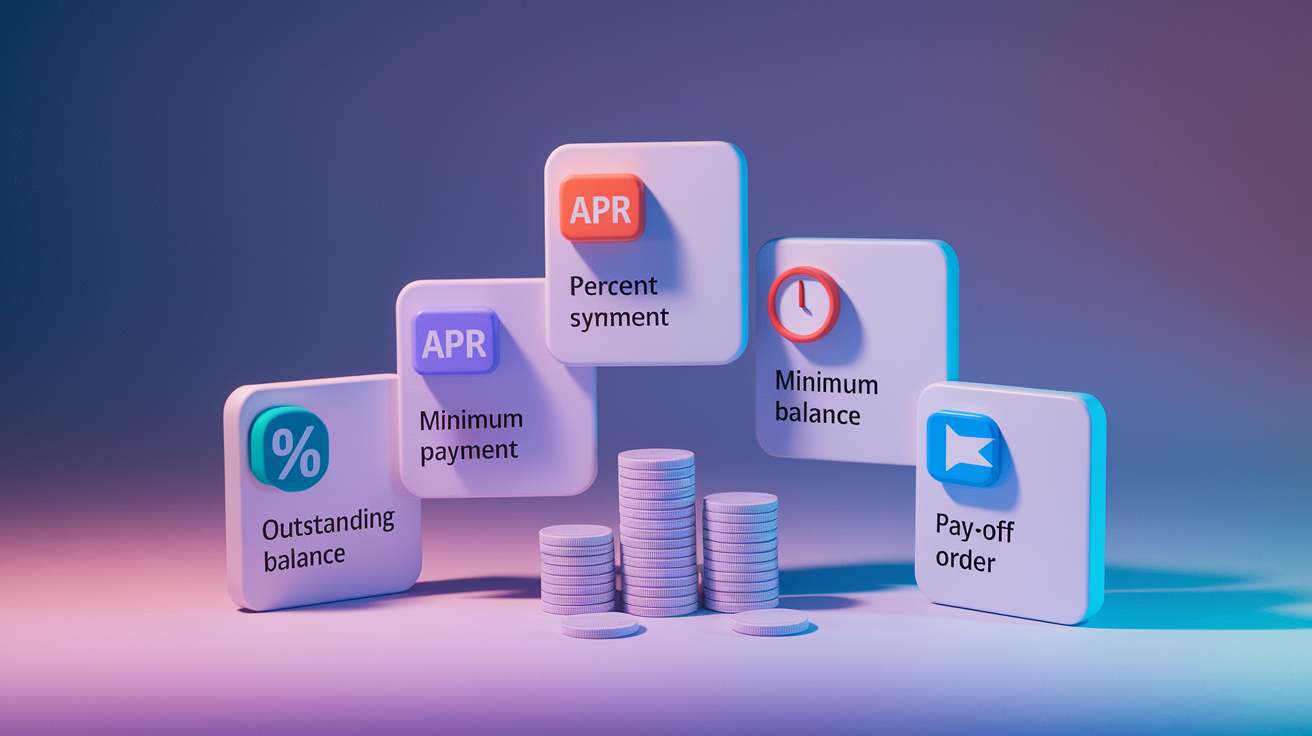
Debt snowball calculators run on a few essential terms. Knowing these helps you read the outputs and tweak things as you go.
The tool uses these to figure out how much of each payment knocks down your principal (what you originally borrowed), how much feeds interest, and how your balance shrinks over time. As debts disappear, you’ve got fewer monthly payments to juggle, which frees up cash and makes life simpler.
| Term | Definition |
|---|---|
| APR | Annual Percentage Rate, the yearly interest cost as a percentage of what you still owe |
| Principal | The original borrowed amount or what’s left before interest piles on |
| Minimum Payment | The smallest monthly payment your lender accepts without hitting you with late fees |
| Outstanding Balance | What you still owe on a debt right now |
| Payoff Order | The sequence debts get targeted and wiped out, smallest balance first in the snowball |
Manual Steps of the Debt Snowball Method

The debt snowball follows a structured process that builds steam as you clear debts. Here’s how it works when you’re doing it by hand, no calculator:
- List every debt you’ve got, credit cards, personal loans, medical bills, car loans, with the current balance, interest rate, and minimum for each.
- Rank them smallest to largest balance, don’t worry about interest rates yet.
- Pay the minimum on everything each month so you dodge late fees, penalties, and credit score hits.
- Throw all extra money past minimums at the debt with the smallest balance.
- Once the smallest is gone, take the total you were paying on it (minimum plus extra) and roll it into the next smallest.
- Repeat the rollover as each debt drops, directing a bigger monthly payment toward the next target.
- Keep the same total monthly payment you started with, never cut your debt payment as balances shrink.
- Keep going until everything’s cleared, racking up wins and momentum with each payoff.
Debt Snowball vs. Debt Avalanche Comparison Within the Calculator

The snowball and avalanche methods use opposite rules, and most calculators let you flip between them to see how your timeline and total interest shift. The snowball hits smallest balance first, like wiping out a $100 doctor bill before a $700 credit card, APR doesn’t matter. The avalanche goes after the highest interest rate first, cutting total interest by attacking the priciest debt immediately.
Quick example: you’ve got a 25 percent APR card with a $1,000 balance, a 22 percent APR card with a $750 balance, and a 15 percent APR card with a $2,000 balance. The avalanche pays the 25 percent card first, then the 22 percent, then the 15 percent. The snowball pays the $750 card first, then the $1,000 card, then the $2,000 card. Avalanche saves more on interest. Snowball delivers faster wins and fewer monthly bills sooner.
Calculators show both methods side by side with payoff order, total months to debt-free, and interest paid for each. You can instantly compare how adding extra payments changes things. The tool makes the tradeoff visible: avalanche is financially optimal if you can stay motivated without quick wins, snowball is behaviorally powerful if seeing debts disappear keeps you consistent.
| Method | First Target | Benefit | Drawback |
|---|---|---|---|
| Snowball | Smallest balance, APR doesn’t matter | Quick wins build motivation, fewer monthly payments faster | Might pay more total interest if high APR debts are large |
| Avalanche | Highest APR, balance doesn’t matter | Cuts total interest paid over the life of the plan | First payoff might take months, tests discipline |
| Snowball with $175 extra monthly | Smallest balance first, accelerated | Shortens timeline a lot while keeping psychological momentum | Still racks up more interest than avalanche with same extra payment |
| Avalanche with $175 extra monthly | Highest APR first, accelerated | Maxes out interest savings, shortens payoff by a month or two vs. snowball | Needs sustained focus on a potentially big first target |
Example Debt Snowball Method Calculator Scenarios and Results

Real numbers make the snowball concrete. Say your total minimums across all debts equal $275. If you pay only minimums, the snowball projects $12,709 total paid over 47 months. The avalanche, targeting highest APR first, projects $12,201 total paid over 45 months. Avalanche saves $508 and finishes two months faster, but snowball delivers quicker elimination of individual debts.
Now add an extra $175 per month past minimums, bringing your total monthly debt payment to $450. Snowball projects $10,374 total paid over 24 months. Avalanche projects $9,922 total paid over 23 months. The gap shrinks to $452 and one month. Extra payments compress the difference because high interest debts get tackled faster either way.
In one specific comparison, switching from snowball to avalanche saved $47 and cut payoff by one month. The difference is small, but it’s real. If your debts are similar in size or if your highest rate debts are also your smallest, the methods might produce nearly identical results. If your high rate debts are large and your small debts carry low rates, avalanche wins by a wider margin.
What the calculator gives you:
- Payoff order, the exact sequence debts get eliminated
- Months to debt-free, the total timeline from first payment to final payoff
- Total amount paid, principal plus all interest across the entire repayment
- Total interest paid, the cumulative interest you’ll pay under each method
- Projected payoff date for each debt, the month and year each balance hits zero
Printable Schedules, Month-by-Month Tables, and Tracking Features in a Debt Snowball Calculator

Most debt snowball calculators spit out a detailed month by month table showing payment, principal paid, interest paid, and remaining balance for every debt in every month. You can expand or collapse individual debt rows to focus on the target or review the full picture. These tables show exactly when each debt vanishes and how your total balance drops over time. Lots of tools let you export the schedule as a PDF for printing or a CSV file for importing into spreadsheet software, budgeting apps, or your own records.
Past raw numbers, calculators often toss in motivational tracking stuff. You might see a progress percentage showing how much of your total debt you’ve cleared, a countdown to your next debt payoff, or badges celebrating your first $1,000 paid off or your first debt eliminated. Some tools show cumulative charts plotting your remaining balance over time, monthly interest piling up, and cash flow requirements, giving you a visual sense of momentum as the snowball picks up speed and your balances drop faster each month.
When a Debt Snowball Method Calculator Works Best and Common Mistakes

The debt snowball works best when interest rates vary across your debts or when your smaller debts carry higher rates than your larger ones. In that scenario, you get the win of quick payoffs without giving up much in total interest. It’s also perfect if you’ve struggled to stick with debt repayment before. Seeing accounts close and monthly obligations disappear can be the motivation you need to keep going for months or years.
The time to become completely debt-free using the snowball typically ranges from a few years, depending on your total debt amount, the spread of interest rates, and how much extra you can afford past minimums. If you’re carrying $20,000 in debt at an average APR of 18 percent and can pay an extra $200 per month, expect a multi year timeline. If your debts are smaller or your extra payment is bigger, you’ll finish faster.
The calculator helps you dodge mistakes by showing you the consequences of different choices in real time. But even with a calculator, certain things trip people up.
Mistakes when using the debt snowball:
- Ignoring high interest piling up, focusing only on small balances while a large, high APR debt racks up interest in the background
- Cutting total payments as debts drop, instead of rolling freed up money into the next debt, you spend it elsewhere and lose momentum
- Adding new debt during payoff, opening new credit cards or taking new loans resets progress and stretches the timeline
- Not budgeting for irregular expenses, missing a debt payment because of car repairs or medical bills derails the entire plan
- Skipping minimums on non target debts, late fees and penalty APRs wreck your payoff schedule and hurt your credit score
- Not adjusting the plan when income or expenses change, job loss, pay cut, or major life stuff require recalculating your extra payment amount
Alternatives to Snowball: Debt Consolidation and Other Payoff Strategies
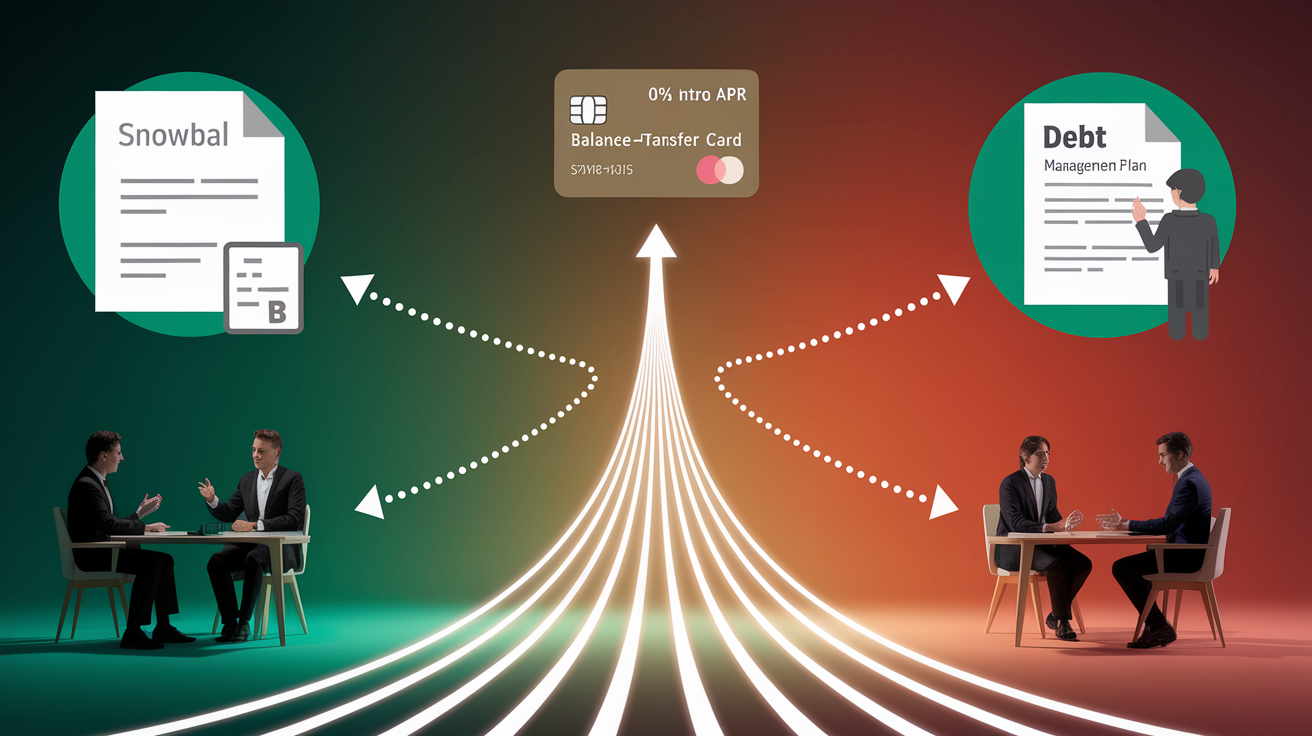
The snowball and avalanche aren’t the only options. Debt consolidation means taking out a single new loan to pay off multiple existing debts, leaving you with one monthly payment and one interest rate. Personal loans used for consolidation might carry origination fees between 1 percent and 6 percent. If you borrow $5,000 with a 6 percent origination fee, the lender takes $300 up front, and you get net proceeds of $4,700. That fee bumps your total cost, so compare the new loan’s APR plus the origination fee against your current weighted average rate before consolidating.
Refinancing high interest debt with a lower rate loan can save real money, especially if your credit score’s improved since you originally borrowed. Balance transfer credit cards with zero percent intro APR periods can also work, but watch for transfer fees (typically 3 to 5 percent of the transferred balance) and be disciplined about paying off the balance before the promo period ends and the regular APR kicks in.
Other payoff strategies:
- Debt settlement, negotiating with creditors to accept less than the full balance, which damages credit and might trigger tax consequences
- Debt management plans, enrolling in a credit counseling program that negotiates lower interest rates and consolidates payments through a third party
- Hybrid snowball avalanche, paying smallest balance first until you hit a milestone, then switching to highest APR to cut interest
- Income driven payoff, aggressively boosting income through side work or job changes and throwing every extra dollar at debt without a rigid method
Final Words
Plug your debts into the tool, set any extra payment, and watch the payoff order, dates, total interest, and month-by-month table update in real time. You get the visual momentum the snowball method promises.
We covered core terms, the manual step-by-step process, snowball vs avalanche tradeoffs, printable schedules, realistic scenarios, when snowball works best, and common mistakes to avoid.
Try the debt snowball method calculator to build a realistic plan, tweak payments, and track progress. Small wins add up. You’re moving toward debt-free, one paid-off balance at a time.
FAQ
Q: How to figure out debt snowball method?
A: Figuring out the debt snowball method means listing debts from smallest to largest, paying minimums on all, and applying any extra cash to the smallest balance until it’s gone, then rolling that payment into the next debt.
Q: Is the snowball method a good way to pay off debt?
A: The snowball method is a good way to pay off debt when you need quick wins to stay motivated; it cuts the number of monthly bills faster but can cost more interest than targeting highest‑rate debts first.
Q: How can I pay off $10,000 in debt quickly?
A: Paying off $10,000 in debt quickly can mean increasing monthly payments (for example, an extra $500 a month can halve the timeline), prioritizing high‑APR balances, or consolidating to a lower‑rate loan.