


Think a lower interest rate always means a cheaper loan? Think again.
Interest rate is the percent charged on your outstanding principal.
APR bundles that rate plus mandatory fees like origination, points, and closing costs into one annualized figure.
That gap can turn a seemingly good deal into an expensive one.
This post shows how to convert APR to a monthly or daily rate, add up fees, and compute the true dollar cost (total payments minus principal).
By the end you’ll know which offer actually costs less and why.
Core Breakdown of APR vs Interest to Calculate a Loan’s True Cost
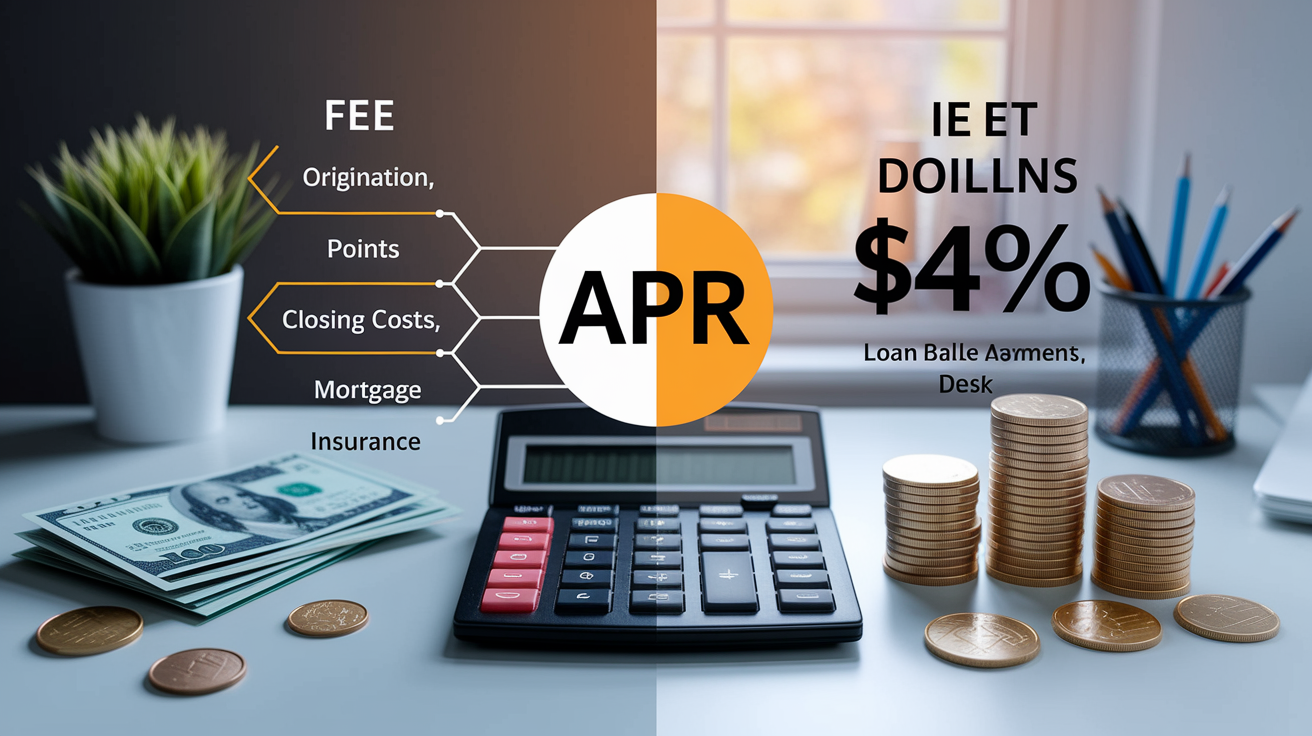
APR is the annual percentage rate that bundles the base interest rate with any mandatory fees: origination fees, points, closing costs, mortgage insurance, and other charges rolled into what you’re actually paying to borrow. The interest rate? That’s just the percentage charged on your principal, shown annually but applied per payment period. When a lender quotes 10% APR, your actual periodic cost breaks down to roughly 0.833% per month (10 ÷ 12) or 0.0274% per day (10 ÷ 365), depending on your payment schedule.
That conversion matters because it shows you how much interest piles up between each payment. The interest rate tells you what the lender charges on the outstanding principal, but it doesn’t capture upfront fees or closing costs. APR does. When you’re comparing two offers, APR gives you the fuller picture, especially on installment loans where fees can be huge. The gap between a 10% interest rate and a 12% APR on the same loan means roughly 2% of your principal got eaten by fees that you pay even though they aren’t pure interest.
True cost is the actual dollar amount you spend beyond your principal. Use this formula: Total dollar cost = (sum of all payments including fees and interest) – principal. If you borrow $30,000 and your total payback is $36,000, your true cost is $6,000. APR expresses that cost as an annualized percentage, which makes comparing loans with different principals easier, but the dollar figure is what you’re actually paying.
To evaluate a loan’s real cost:
- Ask for the total payback amount. The sum of all scheduled payments plus any upfront fees deducted from your principal.
- Subtract the principal from that total payback figure to get total dollar cost.
- Convert APR to your periodic interest rate by dividing APR by the number of payment periods per year (monthly = APR ÷ 12, daily = APR ÷ 365).
- Confirm payment frequency and number of payments. Two loans with the same APR can cost different amounts if one charges daily and the other monthly.
- Compute cost per dollar borrowed. Divide total dollar cost by principal to see how much you’re paying per dollar (example: $6,000 cost on $30,000 principal = $0.20 per dollar borrowed).
Understanding the Interest Rate Component of Loan Cost

Interest compounds at a frequency defined by your loan contract. Most installment loans compound monthly, but some short-term products and credit cards compound daily. That frequency changes how much interest piles up on your outstanding principal. A loan that compounds daily allocates interest each day based on your daily periodic rate, which is your annual rate divided by 365. If your APR is 18%, your daily rate is 0.0493%, and every day you carry a balance you’re accruing that fraction of a percent on whatever principal remains unpaid.
Monthly compounding takes your annual rate, divides by 12, and applies that percentage to your balance once per month when your payment posts. When lenders quote a nominal rate, they’re usually referring to the simple annual rate before compounding, but the actual interest you pay includes the effect of compounding over time. The shorter the compounding interval, the more frequently interest is calculated and added to your balance, which can slightly increase the total interest paid compared to less frequent compounding, even at the same nominal rate.
Periodic interest rate examples by payment frequency:
- Monthly compounding: 12% APR ÷ 12 = 1.00% per month
- Daily compounding: 18% APR ÷ 365 ≈ 0.0493% per day
- Weekly compounding: 26% APR ÷ 52 = 0.50% per week
- Bi-weekly compounding: 10% APR ÷ 26 ≈ 0.3846% every two weeks
What APR Really Includes When Calculating True Loan Cost

APR bundles every mandatory cost you must pay to access the loan into one annualized percentage. It starts with the interest charged on your principal and then layers in upfront fees, points you buy to reduce your rate, closing costs the lender requires, and insurance premiums that are part of the loan package. This means APR can be way higher than the advertised interest rate when fees are large or when you’re borrowing a small amount where a fixed fee takes a bigger percentage bite.
Credit card APRs work differently. The APR quoted on a credit card is usually identical to the interest rate because card issuers don’t wrap in one-time fees like annual fees or balance transfer charges. Revolving credit APR reflects only the interest accrued on your average daily balance, so when you compare credit cards, the APR and interest rate are often the same number. For installment loans (mortgages, auto loans, personal loans), APR always includes mandatory financing charges beyond pure interest. That’s why it’s the better number to use when comparing offers.
Fees that raise APR above the base interest rate:
- Origination fees. Flat or percentage-based charges deducted from your principal at funding.
- Discount points. Prepaid interest you buy to lower your ongoing rate.
- Closing costs. Appraisal, title, processing, and underwriting fees required to finalize the loan.
- Mortgage insurance premiums. PMI or MIP added to loans with low down payments.
- Broker fees. Commissions paid to third parties facilitating the loan.
- Prepaid interest. Interest charged from funding date to your first payment date.
Step-by-Step Guide to Calculating APR and the Loan’s True Cost

Identify Principal, Interest Rate, and Term
Start by pulling the core loan terms: how much you’re borrowing (principal), the annual interest rate the lender quotes, and the repayment term in years or months. These three inputs form the foundation of your calculation. If you’re borrowing $10,000 at a quoted 16% annual rate for three years, you’ve got your starting numbers.
List All Fees to Include
Gather every mandatory charge the lender requires you to pay to access the loan. This includes origination fees, application fees, underwriting fees, appraisal costs, discount points, closing costs, and any insurance premiums rolled into the loan. Don’t count optional add-ons like credit insurance or debt protection unless they’re required to qualify. Add up these fees to get your total fee dollar amount. In the example, if the lender charges a $500 origination fee, that’s the only fee to include.
Calculate Total Payments and Finance Charges
Use an amortization calculator or the lender’s payment schedule to find the total of all scheduled payments over the life of the loan. Then add any upfront fees that were deducted from your principal or charged separately. Subtract the principal from that grand total to get your total finance charges, the dollar cost of borrowing. For a $10,000 loan at 16% over three years with a $500 fee, total payments might sum to $11,956, and adding the $500 fee gives $12,456 total payback, so finance charges are $12,456 – $10,000 = $2,456.
Convert Finance Charges into APR
Divide your total finance charges by the principal, then divide by the loan term in years, and multiply by 100 to express it as an annual percentage. This is a simplified APR approximation. For precise APR, use an online APR calculator that accounts for the exact timing of payments and fee deductions, because APR is technically the internal rate of return on the loan’s cash flows. In the example, $2,456 ÷ $10,000 = 0.2456; 0.2456 ÷ 3 years ≈ 0.0819; 0.0819 × 100 ≈ 8.19% simplified APR estimate, but the true amortization-based APR works out to 19.51% when compounding and payment timing are factored in.
| Input | Fees Included | Total Payments | Final APR |
|---|---|---|---|
| $10,000 principal, 16% rate, 3 years | $500 origination fee | $12,456 | 19.51% |
| $30,000 principal, 6% rate, 7 years | $0 fees | $36,498 | 6.00% |
| $30,000 principal, 7% rate, 5 years | $1,200 origination + $300 processing | $39,800 | 8.42% |
| $30,000 principal, 30% rate, 3 years daily | $0 fees | $47,280 | 30.00% |
Worked Comparison: APR vs Interest Using Real Numbers
Take a $30,000 loan offered at 6% interest with no fees and a seven-year term paid monthly. Total payments over 84 months sum to roughly $36,498, meaning you pay $6,498 in interest and your APR equals the 6% interest rate because there are no fees to add. Now compare that to a $30,000 online loan at 7% with a $1,500 origination fee and a five-year term paid monthly. Total payments reach about $38,300, and when you add the $1,500 fee your total payback is $39,800. Subtract the $30,000 principal and you’ve paid $9,800 in total cost. The APR on that second loan climbs to around 8.42% because the $1,500 fee is spread across five years of payments, raising the annualized cost above the 7% nominal rate.
Shorter-term loans with higher rates can sometimes cost less in total dollars even though the APR looks worse. A $30,000 loan at 40% APR for six months with daily payments might total $34,800 in payback, which is $4,800 in cost, because you’re repaying principal fast and interest doesn’t compound for long. Meanwhile, a $30,000 loan at 30% APR stretched over three years with daily payments can rack up $17,280 in total cost because interest compounds daily for 1,095 days. APR alone doesn’t tell you which loan costs less. You need to calculate total dollar cost and compare that against your cash flow and timeline.
| Loan Type | Term | Payment Frequency | Total Dollar Cost |
|---|---|---|---|
| SBA 7(a), 6% APR | 7 years | Monthly | $6,498 |
| Bank term loan, 7% APR + $1,500 fee | 5 years | Monthly | $9,800 |
| Online loan, 30% APR | 3 years | Daily | $17,280 |
| Short-term online, 40% APR | 6 months | Daily | $4,800 |
How Payment Frequency Changes the True Cost of Borrowing
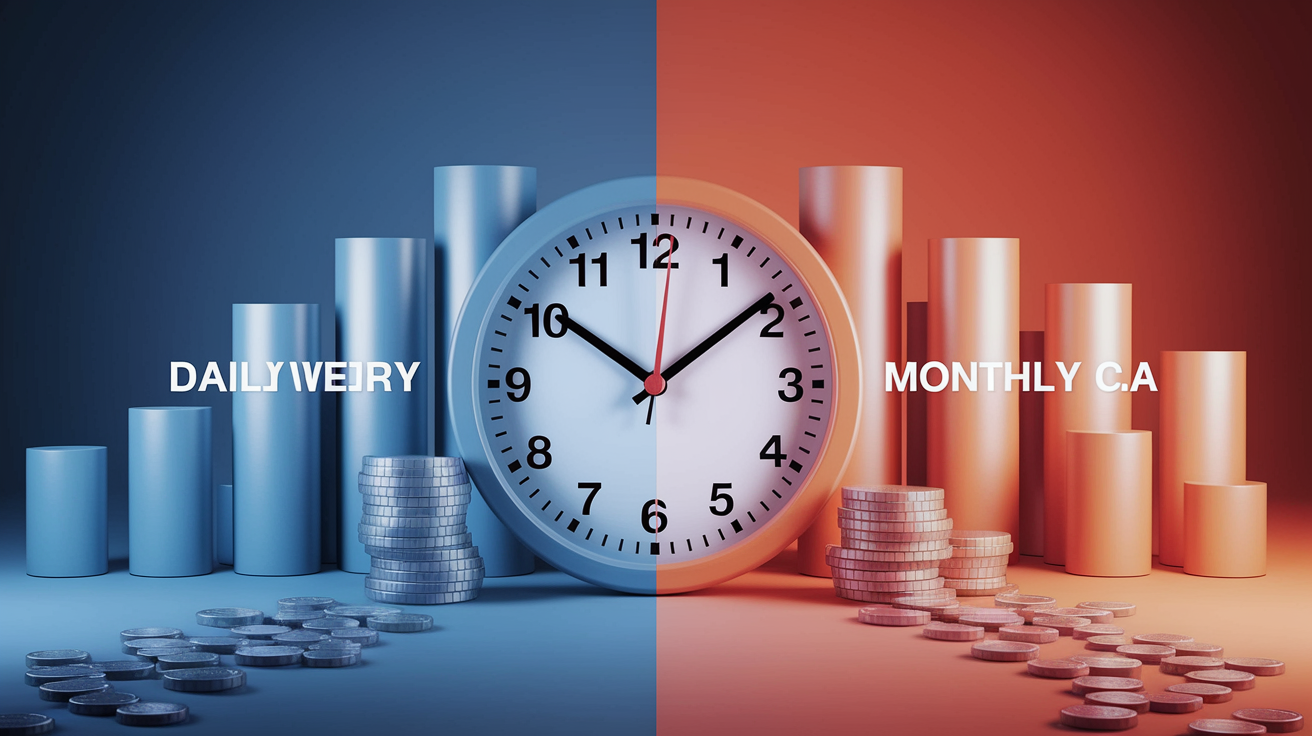
When a loan compounds daily instead of monthly, interest accrues every single day based on your outstanding balance. That means the lender calculates interest 365 times per year rather than 12. A 12% APR on a daily-compounding loan applies 0.0329% to your balance each day (12 ÷ 365), and that small daily charge accumulates faster than a 1.00% monthly charge applied once per month (12 ÷ 12). Even at identical APRs, daily compounding can produce slightly higher total interest than monthly compounding because interest is added to the principal more frequently, creating a larger base for the next day’s interest calculation.
Payment frequency also matters because it controls when principal gets reduced. If you make daily payments, you’re chipping away at the principal every day, which lowers the balance on which interest compounds. Monthly payments leave the principal untouched for longer, so more interest can pile up between payments. Two loans with the same APR and term can result in different total dollar costs when one uses daily payments and the other uses monthly, even if the total number of payments is the same. The loan with more frequent payments usually costs a bit less because principal is repaid incrementally, shrinking the interest base faster.
Effect of payment interval on total cost:
- Daily payments. Principal reduction happens every day, lower balance between compounding events, usually lowest total cost for the same APR and term.
- Weekly payments. Principal reduced 52 times per year, moderate compounding effect, total cost sits between daily and monthly scenarios.
- Monthly payments. Principal reduced 12 times per year, higher compounding effect, typically highest total cost for the same APR and term.
Comparing Loan Offers Using APR, Total Dollar Cost, and Cost per Dollar
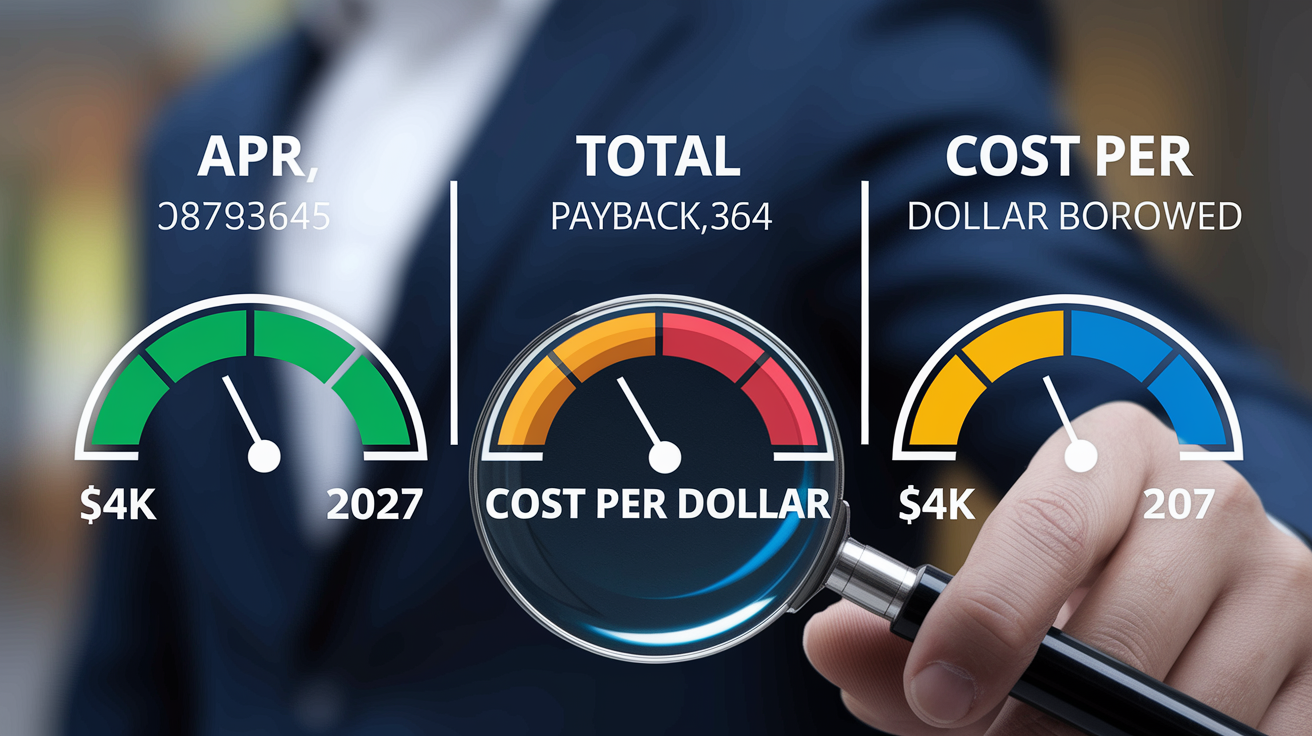
APR works well when you’re comparing loans that share the same term length and payment frequency: both five-year monthly installment loans, or both six-month daily payment products. The moment terms diverge, APR alone can mislead you because a high-APR short-term loan might cost less in total dollars than a lower-APR long-term loan. That’s when you switch to total dollar cost, the actual cash you’ll pay beyond your principal. Request the total payback amount from each lender, subtract the principal, and you have the dollar cost to compare directly.
Cost per dollar borrowed gives you a ratio that’s easy to compare across different loan sizes. Divide total dollar cost by the principal amount. If you’re paying $6,000 in cost to borrow $30,000, that’s $0.20 per dollar. If another offer costs $9,800 on the same $30,000, that’s roughly $0.33 per dollar. The lower ratio means you’re paying less per dollar borrowed, which is a cleaner way to compare when loan amounts differ or when one offer includes a large upfront fee that skews the APR calculation.
Checklist for comparing loans accurately:
- Confirm identical payment frequencies and terms before relying on APR alone. Only use APR to compare when structure matches.
- Request total payback amount and an itemized fee list. Ask the lender to disclose all mandatory charges upfront.
- Calculate total dollar cost for each offer. Subtract principal from total payback to see real dollars paid.
- Compute cost per dollar. Divide total dollar cost by principal to normalize across different loan sizes.
- Match loan purpose to term length. Avoid long-term financing for short-term needs, even if the APR looks attractive.
Hidden Fees and Lender Pricing Tactics That Increase APR
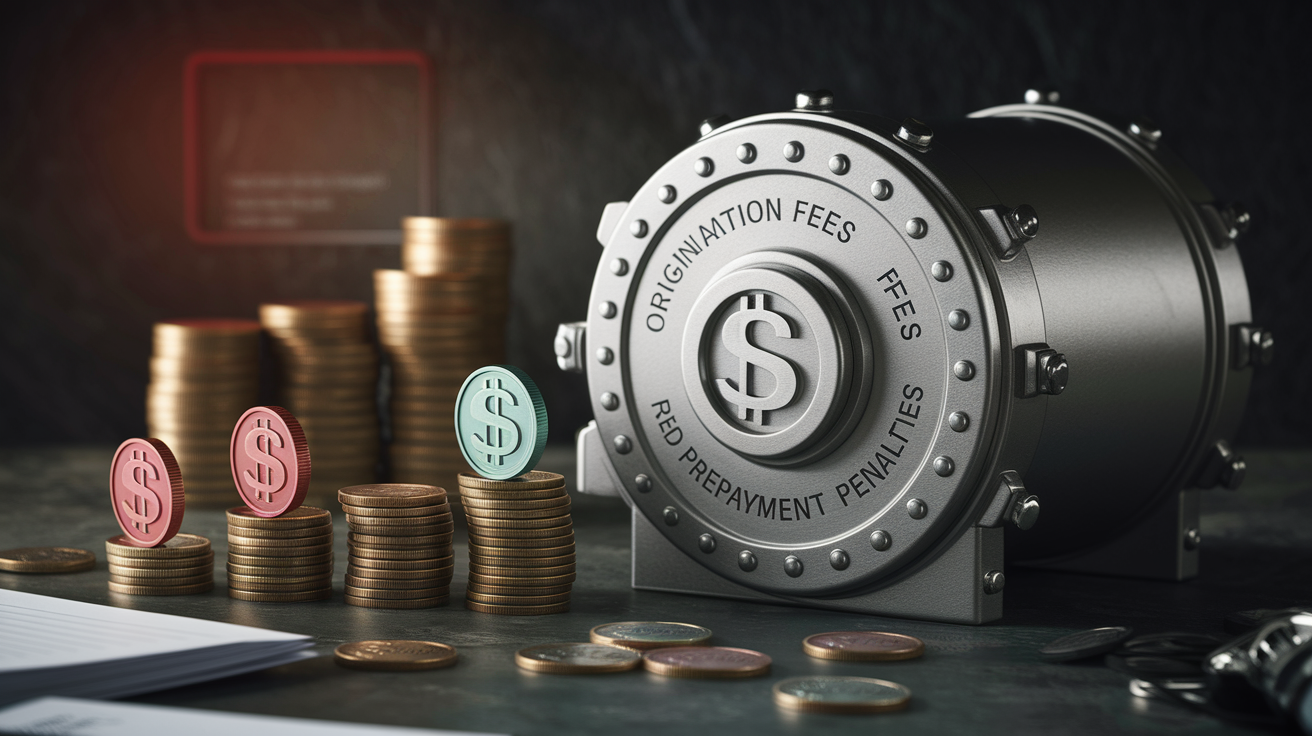
Lenders sometimes quote a low interest rate but layer in fees that push the effective APR way higher. Origination fees are common and can range from 1% to 6% of the loan amount, meaning a $30,000 loan with a 3% origination fee costs you $900 before you even see the money. Processing fees, underwriting fees, and documentation fees are other names for charges that inflate APR without changing the stated interest rate. When these fees are large relative to the loan amount, they can double or triple the gap between the quoted rate and the true APR.
Some lenders use non-APR pricing models: factor rates on merchant cash advances, holdback percentages on revenue-based financing, or discount fees on invoice factoring. These products don’t always disclose an APR, which makes comparison difficult. Convert them into total payback by multiplying the factor rate by your advance amount, then subtract the principal to get total cost. Divide that cost by the principal and annualize it to approximate an APR-equivalent. If a lender won’t give you total payback or APR, that’s a red flag. Ask for it in writing.
Common hidden fees that raise APR:
- Origination or funding fees deducted from the principal at disbursement
- Broker or referral fees paid to intermediaries and passed through to you
- Prepayment penalties that charge you for paying off the loan early
- Add-on insurance or debt protection products bundled into the financing package
Practical Strategies to Reduce APR and Lower Your Loan’s True Cost

Improve your credit score before you apply. Lenders tier their rates by credit profile, and even a 20-point score increase can drop your APR by a percentage point or more. Pay down credit card balances to lower your utilization ratio, make all payments on time for at least six months before shopping, avoid opening new credit accounts in the months leading up to your loan application, and keep older accounts open to maintain a longer credit history. Each of these actions signals lower risk to lenders and opens access to better rate tiers.
Shop at least three lenders and compare APR, fees, and total payback side by side. Many lenders will negotiate origination fees or waive processing charges to win your business, especially if you show them a competing offer with lower fees. Shortening your loan term usually lowers your APR because the lender’s risk decreases when they get repaid faster, and it also cuts total interest paid even if the monthly payment rises. Refinancing an existing high-rate loan into a lower-APR product can save thousands, but only if the new loan’s fees and remaining term result in lower total cost. Run the numbers before you commit.
- Raise your credit score by 20 to 50 points before applying to access lower rate tiers.
- Compare at least three lenders and use competing offers to negotiate fees down.
- Shorten your loan term to reduce APR and total interest, if cash flow allows.
- Avoid long-term financing for short-term needs. Match loan duration to your revenue timeline to minimize interest compounding.
- Refinance only when total cost (new fees + remaining interest) is lower than continuing with your current loan. Calculate break-even before switching.
Final Words
We showed why APR usually sits above the interest rate: fees, points, and insurance add real dollars to what you pay.
You got the step-by-step math — convert APR to monthly or daily rates, add fees, then compute total payments minus principal to find the total dollar cost — plus worked examples.
Use the checklist to compare offers, watch payment frequency, and ask lenders for itemized fees so hidden charges don’t surprise you.
For one clear takeaway on how to calculate the true cost of a loan APR vs interest: focus on total dollar cost, not the headline rate, and you’ll choose cheaper borrowing more often.
FAQ
Q: Is 1% per month the same as 12% per annum?
A: 1% per month is not the same as 12% per annum because monthly compounding raises the effective annual rate to about 12.68% ((1.01)^12 − 1), not exactly 12%.
Q: How does APR measure the true cost of a loan?
A: APR measures the true cost by combining the interest rate plus mandatory fees (origination, points, required insurance) and annualizing those finance charges; total dollar cost equals total payments minus principal.
Q: What is the 3 7 3 rule in mortgage?
A: The 3‑7‑3 rule in mortgage is not a single standardized term; its meaning changes by lender or locality. Ask your lender to define it clearly and get the explanation in writing before agreeing.
Q: How much of a difference is 1% APR?
A: A 1% APR difference changes yearly cost by roughly 1% of the outstanding principal; on a $10,000 loan that’s about $100 extra in the first year, before compounding and fees.