

What if the fastest path to being debt-free isn’t the one that saves the most interest?
The debt snowball method tells you to pay off the smallest balance first, keep making minimums on everything else, and roll each freed payment into the next smallest debt.
That strategy ignores APR on purpose.
But the payoff is behavioral: quick wins build confidence, your monthly payment power grows, and you stay motivated long enough to finish.
This post shows when snowball works, who it helps, and how to use it step by step.
How the Debt Snowball Method Works (Fast Explanation)

The debt snowball method targets your smallest balance first. You keep making minimum payments on all debts, then throw every extra dollar at the account with the lowest balance until it’s paid off. Once that debt is gone, you roll the entire payment amount (minimum plus extra) into the next smallest balance. That’s the snowball. The payment grows as debts disappear.
The method ignores interest rates. It focuses on quick wins and psychological momentum. A small balance might cost you 0 percent interest while a larger balance carries 22 percent, but you pay the small one first anyway because clearing an entire account early builds confidence and keeps you moving.
Here’s how it works with three debts. You have a $500 medical bill (minimum $25), a $1,200 credit card (minimum $40), and a $3,000 personal loan (minimum $100). Your total minimums are $165 per month. You find an extra $100 in your budget, so you pay $125 to the medical bill, $40 to the credit card, and $100 to the loan. After four months the medical bill is paid off. Now you take that $125 and add it to the credit card minimum, paying $165 per month on the card while still paying $100 on the loan. The card clears faster, then you roll $265 into the loan and finish strong.
Step by Step Guide to Using the Debt Snowball
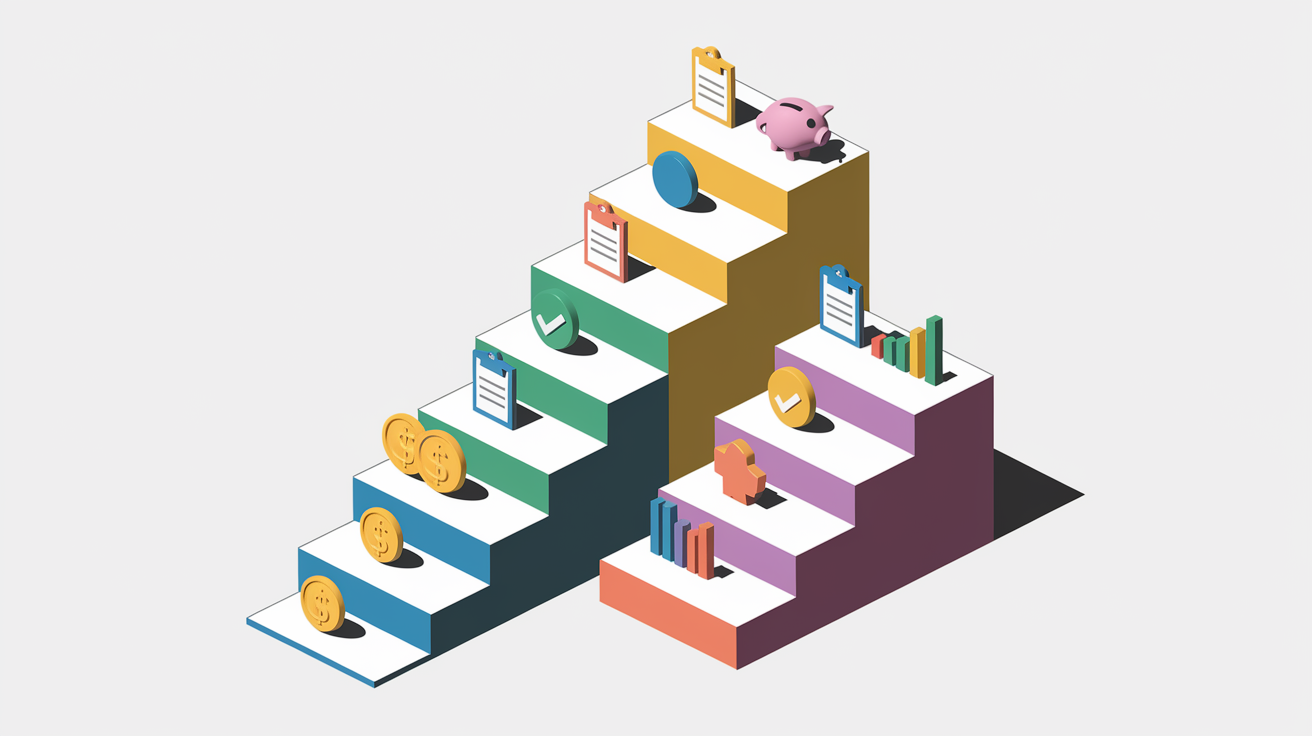
1. List every debt from smallest to largest balance.
Write down each account you owe. Credit cards, personal loans, medical bills, car loans. Arrange them by balance, not interest rate. Exclude your mortgage. Circle the smallest balance. That’s your first target.
2. Make the minimum payment on every debt.
Set up automatic payments for each minimum to avoid late fees and credit damage. Missing a payment while chasing the snowball will cost you more than the method saves. Treat minimums as non-negotiable.
3. Find extra money in your budget.
Review your spending and identify cash you can redirect toward debt each month. Even $50 helps. Look at subscriptions you don’t use, meals out you can skip, or a side project that brings in a little income. Add that amount to your smallest debt’s minimum payment.
4. Pay off the smallest balance first.
Put all your extra money toward the debt with the lowest balance until it hits zero. Keep paying minimums on everything else. The goal is to eliminate one full account as fast as possible, not to chip away at multiple debts at once.
5. Roll the freed payment into the next smallest debt.
As soon as the first debt is paid, take the total amount you were paying (minimum plus extra) and add it to the minimum of the next smallest balance. Your payment power just grew. Repeat this step every time a debt is cleared.
6. Track progress and repeat until you’re debt free.
Each payoff gives you a bigger monthly payment to throw at the next debt. The snowball grows. Keep a written list or use an app to watch balances shrink. When the last debt is gone, you’re done.
Full Worked Example (From Start to Payoff)
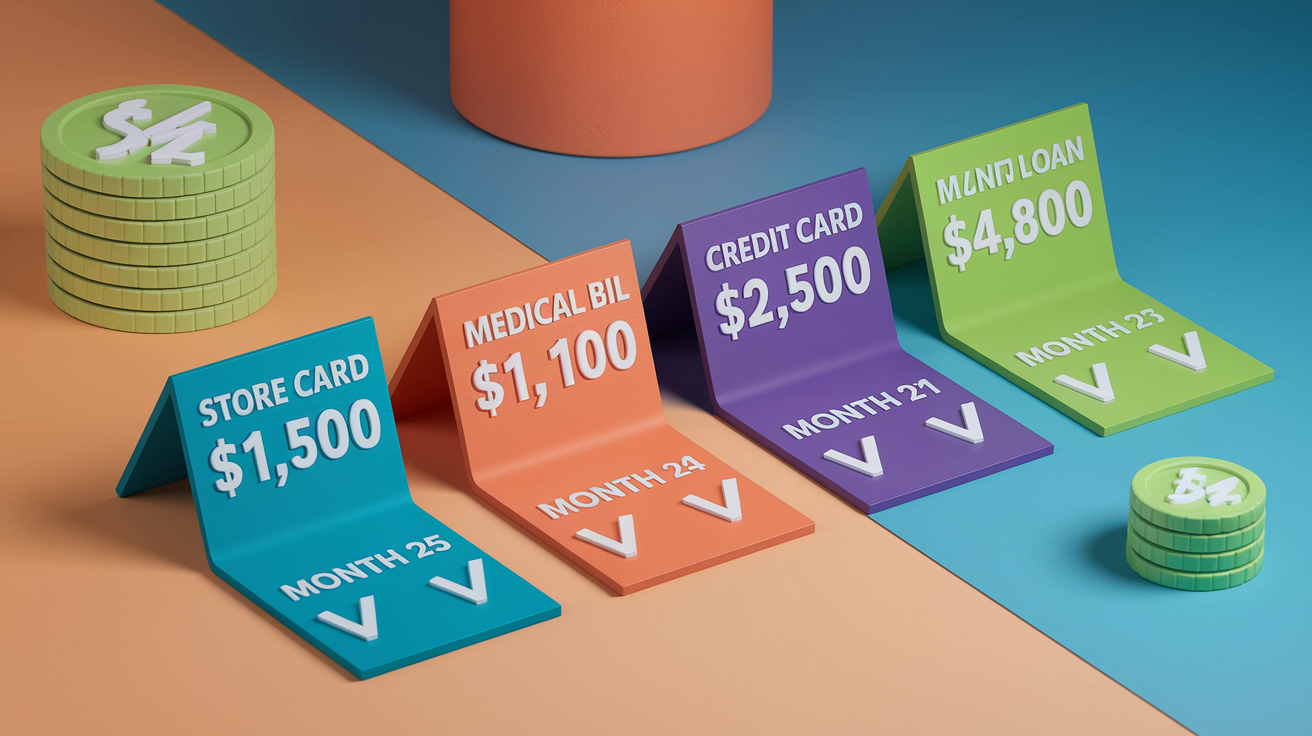
Let’s say you owe four debts: a $600 store card, a $1,100 medical bill, a $2,500 credit card, and a $4,800 car loan. The combined minimums total $215 per month, and you scrape together an extra $135. You start by paying $160 toward the store card ($25 minimum plus $135 extra), $30 to the medical bill, $50 to the credit card, and $110 to the car loan. After four months the store card is paid off.
Now you take the $160 you were paying on the store card and roll it into the medical bill. The new payment is $190 per month ($30 minimum plus $160). Six months later the medical bill is gone. You roll that $190 into the credit card for a total payment of $240 per month ($50 minimum plus $190). The credit card clears in about eleven months. By this point you’ve been in the snowball for roughly 21 months and eliminated three accounts.
Finally, you take the $240 from the credit card and add it to the car loan minimum of $110, making your final payment $350 per month. The car loan balance is knocked out in about fourteen more months. Total time to payoff: roughly three years. The key shift happens after each elimination. Your monthly payment power climbs from $135 extra to $160, then $190, then $240, and finally $350. Each cleared debt makes the next one fall faster.
| Debt | Starting Balance | Minimum Payment | Month Paid Off |
|---|---|---|---|
| Store card | $600 | $25 | Month 4 |
| Medical bill | $1,100 | $30 | Month 10 |
| Credit card | $2,500 | $50 | Month 21 |
| Car loan | $4,800 | $110 | Month 35 |
Pros and Cons of the Debt Snowball Method
Advantages:
Quick psychological wins. Paying off a full account in a few months feels tangible and builds confidence that the plan is working.
Simple to understand and execute. No complicated interest rate math or spreadsheet formulas. Just smallest balance to largest.
Visible progress that maintains motivation. Each closed account is a milestone you can cross off, keeping you engaged over the long haul.
Momentum compounds over time. As debts disappear, freed payments stack into larger monthly amounts that crush remaining balances faster.
Fewer accounts to track. Every payoff reduces the number of monthly bills, simplifying your financial life and lowering the risk of missed payments.
Disadvantages:
Can cost more in total interest. Ignoring interest rates means you might pay a low rate balance first while a high APR debt continues to accrue expensive interest.
Slower to eliminate high interest debt. If your largest balances carry the highest APRs, you’ll face growing interest charges while small balances are cleared.
Not mathematically optimal. A strict focus on APR (the avalanche method) usually results in lower total interest paid over the life of the plan.
Requires discipline to avoid new debt. Paying off a credit card frees up credit, but using it for new purchases undoes the progress.
May take longer to reduce total debt load. Because you’re not prioritizing high balances or high interest, the overall payoff timeline can stretch compared to other strategies if interest compounds significantly.
Debt Snowball vs. Debt Avalanche

The avalanche method flips the snowball’s priority. Instead of targeting the smallest balance, you attack the highest interest rate first while making minimums on everything else. After that debt is paid, you roll the payment into the next highest APR. The math is straightforward: paying high interest debt first minimizes the total interest you’ll pay over time.
The trade off is speed of visible wins. Avalanche can save you hundreds or thousands in interest, but your first payoff might take many months if your highest rate debt also carries a large balance. Snowball sacrifices some interest savings in exchange for early momentum. If a $400 balance can be cleared in two months, that quick win might keep you committed long enough to finish the entire plan, even if it costs an extra $200 in interest compared to avalanche.
| Method | Priority | Best For | Typical Outcome |
|---|---|---|---|
| Debt Snowball | Smallest balance first | People who need early wins and behavioral momentum | Faster psychological progress, may pay more total interest |
| Debt Avalanche | Highest APR first | Disciplined individuals focused on minimizing interest cost | Lower total interest paid, slower initial account closures |
Who the Debt Snowball Method Works Best For

Snowball is built for people who struggle with motivation, feel overwhelmed by multiple debts, or need proof the plan is working before they can stick with it. If you’ve tried to pay down debt before and gave up because progress felt invisible, the snowball’s early wins can break that cycle. It’s also ideal if you carry several small balances. Medical bills, store cards, small personal loans. Things that can be cleared quickly to reduce the mental load of juggling multiple payments.
The method works less well if your primary goal is to save every possible dollar in interest and you have the discipline to follow a strict mathematical plan without needing emotional reinforcement. If your largest debts carry the highest APRs and you can stay motivated through a long initial payoff period, avalanche will cost you less. But if you know yourself well enough to admit that seeing an account balance hit zero is what keeps you going, snowball is the better fit.
Snowball works especially well for:
Individuals with multiple small balances who can knock out two or three accounts in the first year.
People recovering from financial trauma, anxiety, or avoidance who need small, achievable goals.
Households where one partner needs visible progress to stay engaged in a shared debt payoff plan.
Anyone who has abandoned debt reduction efforts in the past due to feeling like nothing was changing.
Motivation Strategies to Stay on Track

Paying off debt takes months or years, and motivation fades without reminders that you’re moving forward. The snowball method builds in psychological wins, but you still need tactics to stay engaged between payoffs.
Print your debt list and tape it somewhere visible. A sheet on the fridge, your workspace, or the bathroom mirror keeps the goal in front of you daily. Cross off each debt as it’s paid.
Use a visual tracker like a debt thermometer or progress bar. Color in a chart as balances shrink. If you have kids, let them help color milestones. It makes the family goal tangible.
Celebrate small wins without spending. After each payoff, acknowledge the achievement with a free reward: a favorite meal cooked at home, a movie night, or a long walk. Keep the celebration guilt free and budget neutral.
Set mini goals between full payoffs. If the next debt will take eight months to clear, break it into $500 chunks and mark each chunk as a win.
Track your interest saved. Use a simple calculator to estimate how much interest you’re avoiding by paying extra. Watching that number grow reinforces the financial benefit.
Join a debt payoff community or accountability group. Sharing progress with others who understand the struggle keeps you committed when motivation dips.
Tools, Apps, and Worksheets for the Debt Snowball

A handful of tools make the debt snowball easier to execute and track. Budgeting apps often include debt payoff features that automate the snowball sequence. You enter each balance, minimum payment, and extra amount, and the app calculates your payoff timeline and shows when each debt will be cleared. Popular options include apps that sync with your bank accounts to track balances in real time and send reminders when payments are due.
Printable worksheets and debt payoff planners give you a manual alternative. A simple spreadsheet or PDF tracker lets you list debts, record monthly payments, and watch balances shrink without needing an app or internet connection. Some people prefer the physical act of writing down each payment and crossing off progress. It reinforces the commitment. Free templates are widely available and easy to customize.
Online snowball calculators let you model different scenarios before you commit. Enter your debts, minimums, and extra payment amounts, then adjust the extra payment to see how much time and interest you save by increasing it. These calculators show side by side comparisons of snowball versus avalanche, helping you decide which method fits your goals. The best calculators break down month by month payment schedules so you know exactly when each debt will be paid and how much interest you’ll pay overall.
Frequently Asked Questions About the Debt Snowball

1. Can I combine the snowball and avalanche methods?
Yes. A hybrid approach targets the smallest high interest debt first, giving you a quick win while still prioritizing APR. If two debts have similar balances, pay the higher rate one first. This blends motivation with math, though it adds complexity to the decision making.
2. What if my income fluctuates each month?
Set your baseline plan using your lowest expected monthly income and treat any extra earnings as bonus payments toward the target debt. Consistency with minimums protects your credit. Variable extra payments still accelerate the snowball without creating risk if a lean month arrives.
3. Should I keep using paid off credit cards?
It depends on your behavior. If you’re confident you’ll pay the full statement balance every month and avoid carrying new debt, cautious use is fine. If there’s any risk you’ll re borrow and undo progress, stop using the card until the entire debt plan is finished.
4. How do I handle a balance transfer offer during the snowball?
A 0 percent intro APR balance transfer can lower interest costs, but only if the transfer fee and your payoff timeline make sense. Run the numbers: if the fee is 3 percent and you’ll pay off the balance within the intro period, it may be worth it. If not, the fee and post intro APR could cost more than sticking with the snowball.
5. What happens if I get a windfall like a tax refund or bonus?
Apply it directly to your current target debt to knock it out faster. A $1,500 refund could eliminate an entire balance and immediately boost your monthly payment power. Resist the urge to split it across multiple debts. The snowball works because you focus fire on one account at a time.
6. Is the snowball method still effective if I have high interest payday loans or credit card debt?
The snowball can work, but extremely high APRs (above 25 percent) accrue interest so fast that paying a small balance first might cost you significantly. In that case, consider a modified approach: clear any small, no interest or low interest debts quickly to free up cash flow, then switch to targeting the highest APR even if the balance is larger. Balance the psychological win against the financial cost.
Final Words
Start by listing your debts from smallest to largest, then push extra cash to the smallest balance—when it’s gone, roll that payment into the next.
We covered how the debt snowball works, a step‑by‑step plan, a full worked example, pros and cons, a head‑to‑head with the avalanche approach, who it suits, motivation tactics, tools, and FAQs.
The snowball method debt repayment gives fast wins and builds momentum. Try it for a few months, track progress, and tweak as needed. You’ll likely feel lighter and more in control.
FAQ
Q: Is the snowball method a good way to pay off debt?
A: The snowball method is a good way to pay off debt if you need quick wins; it closes small balances first to build momentum, though it often costs more interest than targeting high‑rate accounts.
Q: What are the three biggest strategies for paying down debt?
A: The three biggest strategies for paying down debt are the snowball (smallest balances first for motivation), the avalanche (highest interest first to save money), and consolidation (combine debts to lower rates or simplify payments).
Q: Is $20,000 in credit card debt a lot?
A: Whether $20,000 in credit card debt is a lot depends on your income, savings, and monthly budget; for many people it’s high, brings large interest costs, and should be tackled with a clear repayment plan.
Q: How can I pay off $10,000 in debt quickly?
A: To pay off $10,000 in debt quickly, set a monthly payoff target (for example, $500 extra to finish in roughly 20 months), cut expenses, boost income, and consider balance transfers or consolidation if they lower costs.