
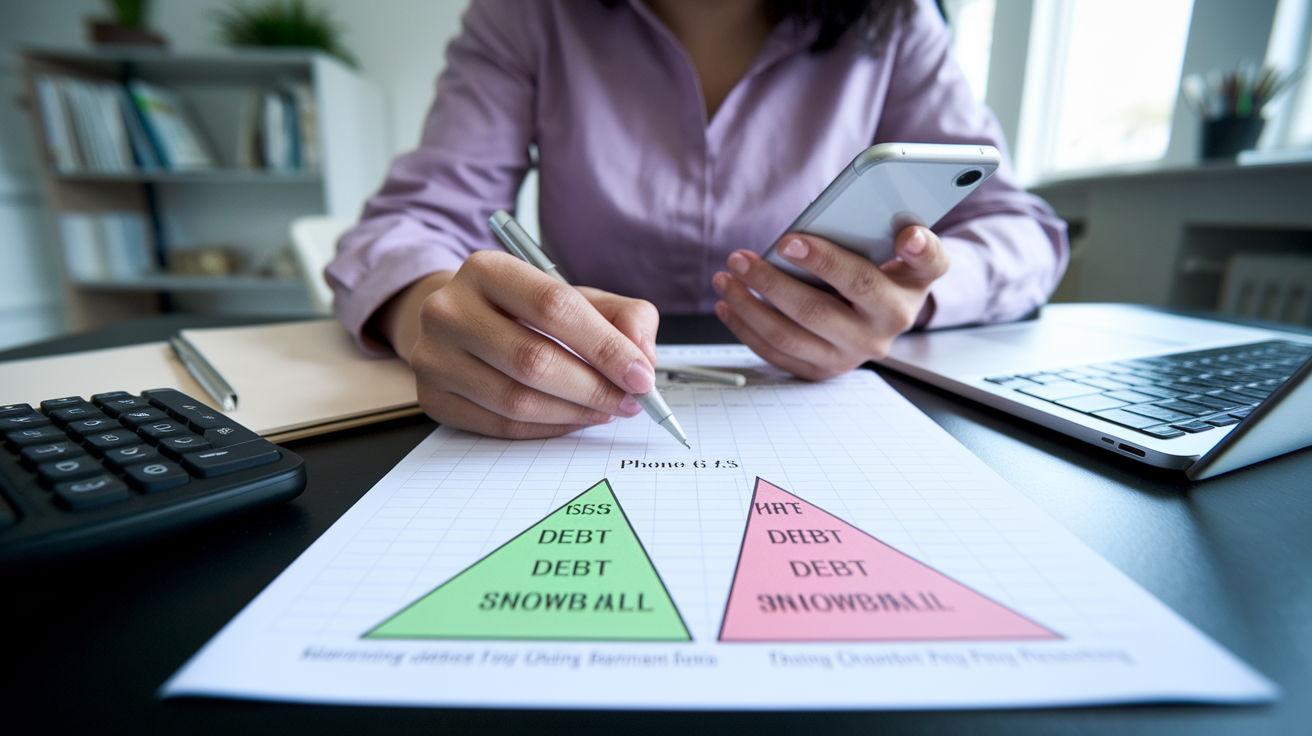

What if paying the smallest debts first is a smarter move than always chasing the highest interest rate?
The debt snowball method does exactly that: you pay minimums everywhere, then throw extra cash at the smallest balance until it’s gone.
When a debt disappears, you roll that payment into the next smallest balance, so your payoff power grows like a snowball down a hill.
It often costs more in interest than rate-focused plans, but for people who need quick wins and a simple, repeatable plan, it raises the odds you’ll actually finish.
Clear Explanation of the Debt Snowball Method and How It Works

The debt snowball method pays off balances from smallest to largest, ignoring interest rates completely. You make minimum payments on everything each month, then throw any extra cash at your smallest balance. Once that’s gone, you take the full amount you were paying on it and roll it into the next smallest debt. Repeat until you’re done.
This isn’t about math. It’s about behavior. Most people with multiple debts lose steam when progress feels invisible. The snowball creates early wins by knocking out small accounts fast, building momentum that keeps you going. You’ll probably pay more interest than you would with other strategies, but you’re also more likely to actually finish.
Here’s how it flows:
Order debts by balance size. List everything from smallest to largest. Interest rates don’t matter here.
Make minimum payments on everything. Keep all accounts current so you don’t wreck your credit or rack up late fees.
Add extra cash to the smallest balance. Whatever’s left after minimums goes entirely to the lowest balance.
Roll the payment forward after each payoff. When the smallest debt disappears, add what you were paying on it to the next smallest balance.
Repeat until you’re debt free. Each cleared account makes the next payment bigger, speeding things up as you go.
Step-by-Step Implementation of the Debt Snowball Method

You need a system. Without a clear plan for finding extra money and applying it consistently, the method never gets off the ground.
Set up automatic minimum payments on every account. Schedule autopay for minimums so you don’t miss due dates or trash your payment history. This keeps everything current while you focus extra money on one balance.
Review your monthly budget to identify extra cash. Look at what’s coming in and going out. Cut discretionary stuff where you can. One fewer meal out, a cheaper streaming plan, skipping a random purchase… that’s $20 to $100 or more you can redirect.
Apply the extra amount to your smallest balance. If the minimum is $25 and you’ve got $50 extra, pay $75 total that month.
When the smallest debt is paid, roll the full payment into the next smallest balance. You were paying $75 on the first debt and it’s gone? Add that $75 to the minimum on the next account. The snowball grows.
Repeat until all debts are eliminated. As each balance disappears, your payment power increases. The last debt gets hit with the combined force of everything before it.
Avoid using paid off credit lines for new purchases. Once a card’s at zero, leave it open for your credit score but stop swiping. New balances undo your work and restart the whole thing.
Consistency beats perfection. Review your budget every few months and don’t pause the snowball for stuff you don’t actually need.
Debt Snowball Method Example With Real Numbers
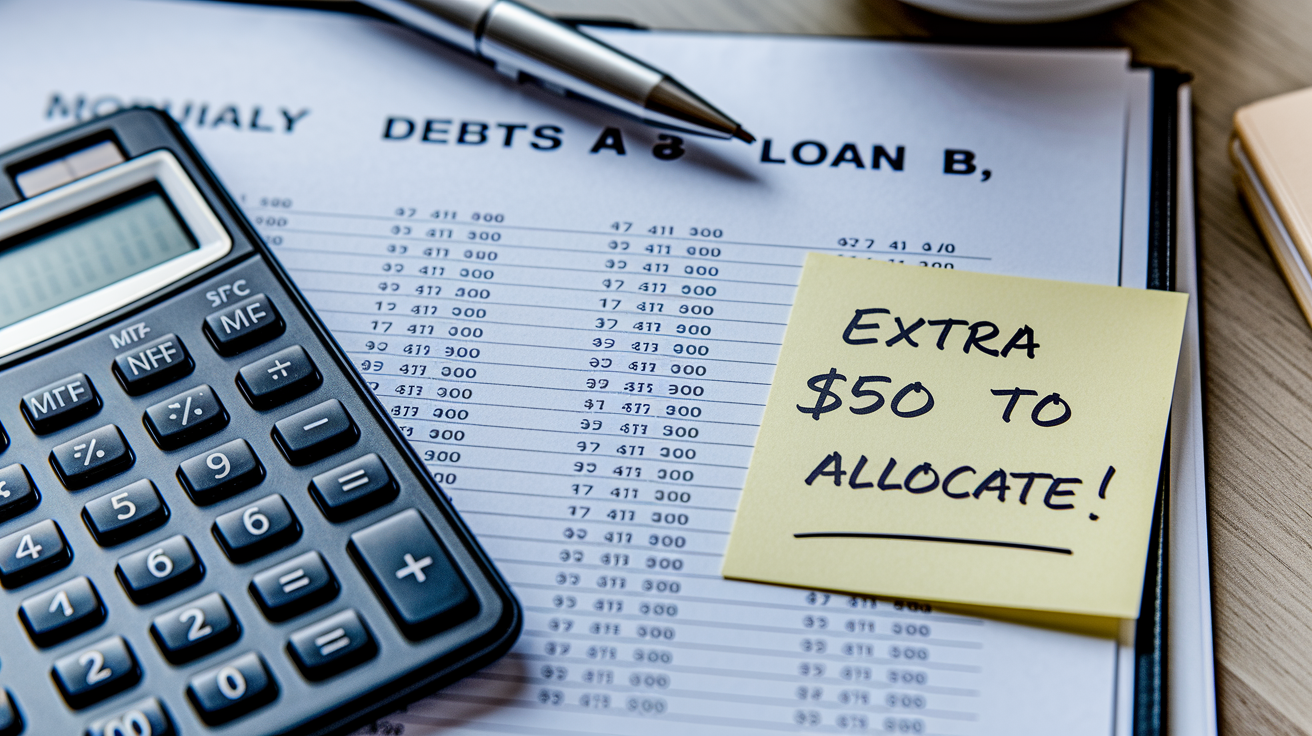
Say you’ve got three debts and can put an extra $50 per month toward them after minimums. Here’s what you’re working with:
| Debt Type | Balance | Minimum Payment |
|---|---|---|
| Credit Card A | $750 | $20 |
| Credit Card B | $1,000 | $35 |
| Personal Loan | $2,000 | $50 |
You pay $20 on Credit Card A, $35 on Credit Card B, and $50 on the personal loan. That’s $105 in minimums. Then you add your $50 extra to Credit Card A, making that payment $70 per month.
Once Credit Card A’s gone, you roll the $70 into Credit Card B, bringing its payment to $105. When Credit Card B disappears, you add $105 to the personal loan payment, so you’re paying $155 per month on the last debt.
Rolling payments forward cuts your timeline and reduces total interest paid. In a bigger example with $150 extra per month, the snowball can shave off more than five years and save over $4,300 in interest compared to minimum payments only.
Pros and Cons of the Debt Snowball Method for Paying Off Debt
The snowball has real behavioral advantages. But there are tradeoffs.
Pros:
Early wins build motivation. Clearing a small balance in a few months gives you visible progress. That helps you stick with it.
Simple to understand and track. No comparing interest rates or running calculations. Just order by size and follow the list.
Accelerates debt elimination as payments roll forward. Each payoff increases what you’re throwing at the next debt.
Reduces the number of accounts and due dates. Fewer open balances means fewer payments to manage each month, which lowers stress.
Cons:
May cost more in total interest than rate focused strategies. Ignoring interest rates can leave high APR balances sitting longer, increasing what you pay overall.
Takes longer to eliminate large, high interest debts if they aren’t the smallest. A $5,000 credit card at 29 percent APR might wait in line behind smaller, lower rate accounts.
Behavioral risk of reusing paid off credit lines. Without discipline, newly available credit can tempt you into new spending that wipes out your progress.
Not ideal for people who prioritize mathematical efficiency. If minimizing interest matters more than psychological momentum, the avalanche method might fit better.
The pros matter most when you’ve struggled to stay consistent before or when you’ve got multiple small balances creating mental clutter. The cons matter most when you’re carrying large balances at high rates and have the discipline to stick with a slower starting plan that saves more money long term.
Comparison: Debt Snowball Method vs. Debt Avalanche and Other Strategies

The debt avalanche prioritizes accounts with the highest interest rate first, ignoring balance size. You make minimum payments on everything and apply extra cash to the highest APR account until it’s paid off, then move to the next highest rate. This minimizes total interest paid and often finishes faster if your highest rate balances are big. But it can feel slow at the start if the first account you’re targeting has a large balance.
The debt snowball prioritizes the smallest balance first, ignoring interest rates. It creates quicker wins and visible progress, which can keep you engaged. If you tend to lose steam on long term financial goals, the snowball’s early payoffs might keep you in the game. The choice between snowball and avalanche depends on whether you value psychological momentum or mathematical interest savings more.
Debt Avalanche
The avalanche targets the account with the highest APR first. Extra payments go there while minimums continue on everything else. Once the highest rate debt’s paid, the full payment rolls to the next highest rate. This saves the most money on interest and often shortens total payoff time, especially when high rate debts have large balances. The downside is slower early progress if your highest rate account is also your biggest balance, which can make it harder to stay motivated.
Debt Consolidation
Debt consolidation combines multiple balances into a single loan or balance transfer credit card, ideally at a lower interest rate. A personal loan can simplify payments and reduce interest charges if your credit qualifies you for a competitive APR. A 0 percent intro APR balance transfer card can eliminate interest for 12 to 21 months, letting you pay down principal faster. The tradeoffs: consolidation requires good credit to access favorable rates, balance transfer cards charge fees (usually 3 to 5 percent), and both strategies demand discipline to avoid running up new balances on the accounts you just paid off.
Credit Counseling
Credit counseling agencies can negotiate lower interest rates and monthly payments with your creditors through a debt management plan. You make one monthly payment to the agency, which distributes it to your creditors. This can reduce stress and lower costs, but plans often require closing the enrolled accounts and may include setup or monthly fees. Credit counseling works best when you’re struggling to make minimums or when creditors are willing to reduce rates significantly in exchange for structured repayment.
When to Use the Debt Snowball Method and Who Benefits Most

The debt snowball works best for people who need motivation and simplicity more than interest optimization. If you’ve got multiple small balances scattered around, clearing one or two quickly can create the psychological push to keep going. It’s especially useful if you’ve tried to pay down debt before and stalled because progress felt invisible or overwhelming. The method also fits people who prefer a straightforward plan they can follow without running calculations or worrying about APR differences.
The snowball’s less ideal when minimizing total interest cost is your top priority. If you’re carrying large balances on high interest credit cards (say, $8,000 at 27 percent APR) and your smallest balance is a $1,500 personal loan at 9 percent, the snowball will direct extra payments to the personal loan first. That means the high rate credit card sits longer, accruing more interest. In that scenario, the debt avalanche or a consolidation loan may save you more money and finish faster.
Common mistakes that kill the debt snowball plan:
Skipping minimum payments on other accounts. Every debt must get at least its minimum payment each month. Skipping minimums to throw more cash at the smallest balance will trigger late fees and damage your credit.
Using paid off credit cards for new purchases. Once a card’s at zero, resist the urge to use it again. New balances restart the cycle and erase your progress.
Not adjusting the plan when income or expenses change. If your budget tightens, reduce the extra payment temporarily rather than abandoning the plan entirely. If income increases, add the new cash to the snowball.
Focusing on the plan without building an emergency fund. Without a small cash cushion, unexpected expenses force you back into debt. Shoot for $500 to $1,000 in savings before aggressively attacking debt, or build it alongside the snowball by splitting extra cash between savings and debt.
Tips to Stay Consistent With Your Debt Snowball Plan
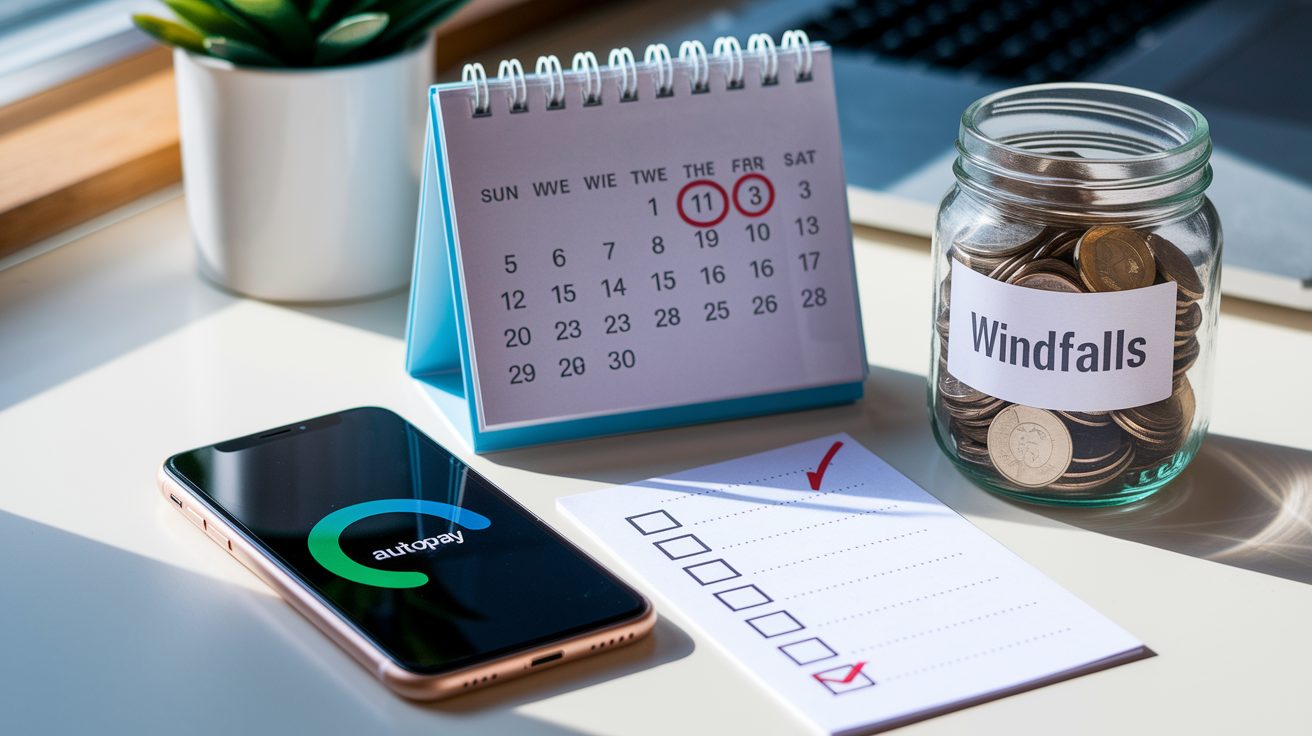
Consistency’s hard because life interrupts budgets, motivation fades between payoffs, and the temptation to spend freed up cash is real. The gap between starting a debt repayment plan and finishing it is where most people lose momentum. Staying on track requires small systems that remove friction and keep the snowball rolling month after month.
Automate the process wherever possible. Set up autopay for minimum payments on all accounts and schedule a recurring transfer from checking to the debt with the smallest balance on the same day each month. Automation removes the decision and reduces the chance you’ll skip a payment or forget the extra.
Celebrate each payoff without derailing progress. When a balance hits zero, acknowledge the win. Mark it on a calendar, share it with an accountability partner, or take a small, budgeted break. Then get back to the plan. Celebrating keeps motivation high without blowing the budget.
Apply windfalls and side income directly to the snowball. Tax refunds, work bonuses, garage sale cash, or freelance income can wipe out a small balance in one payment or cut months off a larger one. Redirect windfalls before they disappear into regular spending.
Use “debt snowflakes” to add small amounts regularly. Small savings (skipping one coffee shop trip per week, canceling an unused subscription, selling something you don’t need) add up. Apply these micro savings to your smallest balance alongside your monthly extra payment.
Track your progress visually. Use a spreadsheet, app, or notebook to log each payment and watch balances shrink. Seeing the numbers move down reinforces that the plan’s working.
Find an accountability partner. Share your plan and monthly progress with a friend, family member, or online group. Knowing someone else is checking in makes it harder to skip a month or backslide into new debt.
If an emergency hits (car repair, medical bill, job loss), pause the extra payments temporarily and redirect cash to cover the immediate need or rebuild your small emergency fund. Once the crisis passes, restart the snowball where you left off. Flexibility during real emergencies keeps the plan sustainable long term.
Final Words
We defined the debt snowball method, explained how it orders debts from smallest to largest, gave step-by-step actions, walked through a numbers example, compared it to avalanche and consolidation, and listed practical tips to stay consistent.
Remember the tradeoff: it buys psychological wins and momentum at the cost of potentially paying more interest. It’s best when you need motivation and simple rules.
If you still ask “what is the debt snowball method”, it’s a smallest-first payoff plan that turns each cleared balance into extra payment power. Use it to build confidence and keep moving toward debt-free.
FAQ
Q: Is it better to snowball or avalanche?
A: The snowball method is better when you need quick motivation and have multiple small balances; the avalanche method is better when you want to minimize total interest, especially with high-rate debts.
Q: How long will it take to pay off $20,000 in credit card debt?
A: The time to pay off $20,000 in credit card debt depends on APR and monthly payment; for example, at 18% APR paying $500/month ≈5.1 years, while $1,000/month ≈2.0 years.
Q: What are the three biggest strategies for paying down debt?
A: The three biggest strategies for paying down debt are the debt snowball (smallest-balance first), the debt avalanche (highest-rate first), and debt consolidation or counseling to lower rates and simplify payments.
Q: How can I pay off $10,000 in debt quickly?
A: You can pay off $10,000 quickly by raising monthly payments (for example, $500/month pays it in about 2 years at 18% APR), cutting expenses, adding side income, and using windfalls or 0% transfers.